Resumen
El desarrollo de las habilidades lectoras en inglés como lengua extranjera (EFL) constituye un desafío pedagógico persistente, especialmente en contextos donde los estudiantes tienen una exposición limitada a la lengua meta fuera del aula. El objetivo principal fue analizar el uso de plataformas de lectura gamificadas para apoyar el desarrollo de la lectura y la comprensión lectora en los estudiantes de la Escuela Pública de Pajan. Plataformas como Raz-Kids, ReadTheory, ¡Epic! y CommonLit combinan tecnología educativa con elementos de gamificación, fomentando la participación del estudiante y apoyando el desarrollo de la comprensión lectora y la producción escrita. Este proyecto adopta un enfoque mixto, combinando el análisis bibliográfico y la recopilación de datos de campo mediante encuestas a docentes, con el objetivo de generar conocimiento práctico y contextualizado que enriquezca la enseñanza y el aprendizaje del inglés mediante inteligencia artificial. La evidencia empírica de estudios educativos recientes indica que el uso sistemático de plataformas digitales de lectura contribuye a una mayor motivación lectora y a mejoras significativas en los resultados de comprensión lectora, especialmente entre estudiantes de educación primaria y secundaria. Sin embargo, la implementación efectiva de estas herramientas depende de diversas condiciones contextuales, como el acceso equitativo a los recursos tecnológicos, una conexión a internet fiable, una formación docente adecuada y una integración curricular rigurosa y alineada con los objetivos educativos.
Palabras clave: Aplicaciones; motivación; procesos; tecnología
Fecha de recibido: 22/11/2025
Fecha de aceptado: 20/02/2026
Fecha de publicado: 03/03/2026
Introduction
Teaching English is essential for current academic and professional development. In Peruvian military schools, this skill takes on even greater relevance due to its representative role at the national and international levels. Therefore, gamification is presented as a promising educational strategy to transform the learning process into a more engaging and interactive experience. Adapting to new situations is driven by these advances, which also has a significant impact on the educational environment. The use of computers, tablets, and smartphones has increased, not only for academic purposes but also in recreational activities, which present numerous positive characteristics that can be leveraged for student learning (González et al., 2023).
An essential aspect of language use is reading ability, a skill that not only facilitates access to texts in English but also aids in the development of other language skills such as vocabulary, grammar, and writing. However, many students experience difficulty reading materials in a different language due to language barriers, lack of motivation, or limited resources tailored to their level and situation. In this regard, educational innovation has begun to explore new strategies and tools that promote meaningful language learning, with gamification being one of the most relevant (Sany, 2022).
For many years, the ability to comprehend what is read has been a fundamental competency in teaching English as a foreign language, as it allows students to access knowledge, analyze information, and develop opinions in a language other than their own. Over time, different approaches have been proposed to improve this skill, from traditional methods that focus on the translation of texts to communicative approaches that integrate reading into more authentic and meaningful contexts. However, the challenge many students face in actively engaging in reading activities has been a persistent concern in educational research.
In the current situation, the emergence of technological tools for education has marked a turning point in language learning. The emergence of online platforms has allowed teachers access to a wide variety of interactive and customizable materials, and students to benefit from more enjoyable study methods tailored to their needs (Acevedo & Castillo, 2023). The ability to understand what is read is crucial for learning a foreign language, as it allows students to access a wide range of information and enrich their vocabulary, grammar, and cultural knowledge. Reading platforms that integrate gamification offer features such as rewards, levels, avatars, and immediate feedback to increase student motivation and engagement. These tools not only encourage more frequent and prolonged reading but also offer interactive activities that promote a deeper understanding of the text. In the field of teaching English as a second language, this approach is especially useful, as students often encounter emotional and cognitive barriers that gamification helps overcome (Sánchez, 2022).
Unlike conventional methods, these platforms offer texts organized by difficulty level, adapting to each student's language abilities. This facilitates logical progression at each student's learning speed. Furthermore, many of these tools include interactive activities that improve reading comprehension, allowing for the application of strategies such as anticipation, identification of main and secondary ideas, formulation of inferences, and deduction of meaning based on context, all within an engaging digital environment that captures students' interest (Fernández T. P., 2019).
Teaching English as a second language has become a global priority due to the growing interconnectedness and importance of the language in various professional and academic fields. In this context, innovative educational strategies, such as gamification, have emerged as effective tools for improving students' language skills. This literature review examines the application of gamification in developing English language skills and reviews educational strategies that have proven effective in the context of second language learning (Ushiña et al., 2024).
In this context, integrating digital gamified platforms into English instruction has emerged as a promising strategy to improve reading comprehension. These platforms combine pedagogical content with interactive elements, aiming to enhance student motivation, personalize learning paths, and provide immediate feedback. The main goal was to analyze the use of gamified reading platforms to support the development of reading and comprehension skills in students at Pajan Public School.
Theoretical Framework: Reading Comprehension in Foreign Language Learning
Teaching English as a foreign language (EFL) faces several challenges, most notably the urgent need to strengthen reading comprehension skills. Given this situation, recreational reading platforms have emerged as ingenious alternatives that merge technology with entertainment elements, seeking to motivate and improve student learning. This study examines the theoretical foundations and evidence that validate the use of these tools to boost reading comprehension in EFL (Guarín & Ramírez, 2019).
Text comprehension represents an essential cognitive skill that helps students comprehend, analyze, and reflect on the material they have read. In the context of English as a foreign language, this skill goes beyond simple word decoding, including the ability to infer meaning, identify central and supporting ideas, and connect information to prior knowledge. Reading in English is fundamental to students' overall development, influencing their cognitive progress and the acquisition of new vocabulary and modes of expression (Martínez, 2019).
In learning English as a foreign language, this skill goes beyond simply translating words, encompassing the ability to infer implicit meanings, distinguish between key concepts and supporting details, and connect what they read with their prior knowledge. Reading in English is vital to students' overall growth, positively impacting both their cognitive development and their acquisition of new words and forms of expression (Fernández T. P., 2019).
Understanding what you read is crucial when learning another language. It not only allows you to learn information, but also boosts your critical thinking, enriches your vocabulary, and reinforces your use of grammar. This skill involves more than just understanding individual words; it involves a complex process of making sense of everything, requiring you to use your linguistic, cognitive, and reflective skills simultaneously (Quesada et al., 2021). Motivation is essential for reading comprehension, particularly when learning a new language. When students are inspired to read, they typically pick up challenging books, continue reading, and apply comprehension methods (Fraggioli, 2020).
When studying English as a foreign language, reading serves as both a means and an end in itself. It provides the student with the opportunity to acquire new words, understand the rules of the language, and delve deeper into the cultural elements of the language they are studying. However, this progress is generally based on the reader's language skills. English learners outside their native country encounter several difficulties when reading: restricted word comprehension, unfamiliar sentence patterns, minimal exposure to idioms, and insufficient cultural insights related to the written material. These limitations mean that understanding English texts for non-native speakers requires tailored teaching methods to overcome these challenges (Ussa, 2019); (Romero, 2022).
Motivation for reading foreign languages is crucial for success in language learning. A positive attitude toward reading, combined with effective strategies, can significantly improve the comprehension and enjoyment of foreign language texts. Learning a foreign language can be an interesting, easy, and productive experience for some people, but boring, complicated, and even useless for others. However, the fact is that in most cases, regardless of how one perceives it, students do not achieve the same proficiency in the foreign language as they do in their native language (Bilbao, 2019).
In the field of language teaching, the idea that success is closely linked to the level of student motivation is also commonplace. The basic distinction between integrative motivation and instrumental integration, first introduced by Gardner and Lambert in 1972, although revealing in that it draws attention to how ultimate goals act as powerful motives that correlate with the level of proficiency achieved, nevertheless seems excessively static and limited, as language teachers identify successes and failures that cannot be explained in terms of this distinction (Barrios, 2023).
In a broad sense, "motivation" is the name of a complex phenomenon that attempts to explain why people behave the way they do, and as such, it affects everyone and all areas of life. In the field of teaching, everyone knows, even if they're not a teacher, that a book with color pictures is more "motivating" than one in black and white. Or that L2 classroom activities that use video will, in principle, be much better received than those based on paper. And that a dynamic, energetic, smiling teacher will motivate her students better than a serious, inactive one (Castro, 2021).
Gamification in Education: Theoretical Foundations
Gamification in education is a pedagogical strategy that uses game design elements, such as points, badges, levels, and rewards, to motivate students, increase their engagement, and enhance their learning. It is based on learning theories such as constructivism, connectivism, and self-determination theory, as well as flow theory (Sánchez, 2022). In the current educational context, the search for innovative pedagogical approaches that stimulate the development of cognitive skills is essential; therefore, the study focuses on gamification, an educational strategy that incorporates game elements into learning environments and has proven effective in various contexts.
Gamification is based on the use of video game design elements in non-game contexts to make a product, service, or application more fun, engaging, and motivating. By introducing game mechanics and approaches, the goal is to engage users. Gamification is thus defined as the use of game designs and techniques in non-game contexts to develop developmental skills and behaviors. In this context, our approach to gamification refers to the application of game mechanics to non-game environments, in order to stimulate and motivate both competition and cooperation among players (Ortiz, 2019).
Gamification is a learning technique that transfers game mechanics to the educational and professional fields to achieve better results, whether through better knowledge absorption, improved skills, or rewarding specific actions, among many other objectives. This type of learning is gaining ground in training methodologies due to its playful nature, which facilitates the internalization of knowledge in a more fun way, generating a positive user experience. The game model really works because it motivates students, developing greater engagement and encouraging a desire for improvement. A series of mechanical and dynamic techniques extrapolated from games is used (Gaitán, 2020).
In the current educational context, the search for innovative pedagogical approaches that stimulate the development of cognitive skills is essential; therefore, this study focuses on gamification, an educational strategy that incorporates game elements into learning environments and has proven effective in various contexts. Consequently, the objective was to analyze the theoretical foundations that support gamification without digital resources in strengthening logical-mathematical intelligence, emphasizing the theoretical contributions that support this topic. The methodology used was based on documentary analysis, which is defined as a mechanism that allows for a detailed analysis of content in order to provide a more in-depth look, emphasizing essential aspects (Berrocal, 2024).
Gamified Reading Platforms: Features and Benefits
The rise in the use of digital resources in education is evident, especially for foreign language instruction. In this context, reading platforms with game elements have gained importance, standing out as a novel way to motivate students, spark their curiosity about reading, and improve reading comprehension, especially where English as a Foreign Language (EFL) is taught. Gamification in teaching, understood as the incorporation of game dynamics in educational contexts, has positioned itself as a method that seeks to transform traditional teaching into a more dynamic, participatory, and student-centered experience.
By employing this technique in digital reading platforms, it is possible to create virtual spaces that not only provide reading materials but also accompany them with challenges, rewards, immediate information, and personalized paths, turning reading into something fascinating. In an EFL context, where students often view reading in English as a difficult or boring task, these platforms capture their interest by presenting texts in interactive stories or within missions, challenges, or role-playing simulations (Fernández T. P., 2019).
This allows readers to connect emotionally with the material, facilitating content comprehension, information memorization, and the development of language skills in a more natural and effective way. Furthermore, gamified reading platforms are typically designed to adapt to the user's proficiency level. They use algorithms that modify the complexity of texts and comprehension tasks based on the student's progress. This adaptability is very useful in heterogeneous learning groups, where English proficiency levels can vary greatly among students (Guarín & Ramírez, 2019). These platforms merge the worlds of technology, pedagogy, and the psychological principles that govern games. The goal is to encourage, entertain, and improve reading comprehension skills, especially among children, young people, and students who struggle to read independently (Macedo, 2023).
Reading tools that utilize playful features represent a valuable educational advancement. By blending play with reading, they transform the way we relate to texts and make reading something active, meaningful, and fulfilling. These tools do not seek to replace traditional books, but rather to improve their use and help develop readers with motivation, analytical skills, and independence, which is key to learning in this century (Pérez et al., 2023).
Educational and Cognitive Benefits of Gamified Reading Tools
Reading platforms with game elements not only modernize the reading activity, but also provide tangible educational benefits: Increased Motivation to Read: The use of incentives and defined goals transforms reading into an engaging activity, especially for children who are not naturally inclined to read. Improved Comprehension and Retention: By incorporating interactive assessments and instant feedback, they reinforce text comprehension and encourage critical thinking. Promoting Autonomy: Students can select their reading material, progress at their own pace, and conduct self-assessments, which fosters a more responsible and independent attitude toward learning. Attention to Diversity: By offering adapted levels, they make it easier for readers with different paces and abilities to learn without becoming frustrated or bored (Sanchez, 2020).
Improved Academic Performance: Numerous studies have indicated that the continued use of gamified reading platforms boosts vocabulary, reading fluency, and performance in other academic areas. Ongoing, Real-Time Assessment: Teachers can intervene promptly, personalize strategies, and make educational decisions based on accurate data (Sanchez, 2020).
Some platforms recognized for applying gamification to reading are:
TumbleBooks: a digital catalog with animations and quizzes. Lecture Lab, a Spanish-language platform with challenges and teacher monitoring. Biblionasium – Social network for readers with peer challenges. Epic! (Very popular in the US with reward elements and interest-based selection. Leoteca). A children's platform that rewards reading habits and creates virtual book boxes.
Platforms that use games to teach reading combine digital tools with playful techniques, providing interactive and tailored reading experiences. These platforms typically include features such as: Interactive Stories: Students actively participate in creating the story, deciding the direction the narrative will take through choices that influence the development of the text. Instant Feedback: Immediate feedback is provided on student progress, allowing for instant changes and promoting independent learning.
Game Components: Elements such as points, badges, and rankings are added to encourage students to improve their performance and participate consistently. Easy Access and Adaptation: Platforms typically offer customization options, such as changing font size, colors, and reading speed, to meet different student needs. The use of these platforms has been shown to have several benefits in developing reading comprehension in English as a foreign language. Increased Motivation: The inclusion of game elements makes reading more engaging and entertaining, which increases students' interest in reading in English.
Increased Engagement: Interactive activities and challenges promote greater student participation in the reading process. Key Skill Development: The need to make decisions and solve problems within stories reinforces critical thinking and analytical skills. Personalized Learning: Platforms allow activities to be tailored to each student's needs and learning pace, fostering a more inclusive education (Sánchez, 2022).
Gamification: A technological breakthrough in digitalization. Gamification, as an advanced in digitalization, refers to the application of game elements and mechanics in non-game contexts to motivate and engage users, encouraging their participation and learning, especially in the educational field. Gamification is based on psychological and pedagogical principles that emphasize the importance of personal motivation and active participation in learning. People are more engaged when they feel independent, competent, and connected. The goal of gamification is to meet these needs, offering students learning experiences that are both challenging and rewarding. Within a gamified environment, students can learn from their peers through collaboration, healthy competition, and the feedback they receive, which enriches their learning process. (Calderón, 2022)
In the educational field, gamification has been implemented through various online tools and platforms. These integrate game dynamics to simplify the learning process. Among the most popular are: Kahoot! A platform that facilitates the creation of interactive quizzes and trivia games, encouraging participation and healthy competition among students. In addition to making learning more engaging, these platforms provide useful information on student progress, allowing for effective and tailored assessment (Guarín R. M., 2019). Integrating game dynamics into digital education brings considerable benefits: Increased motivation and engagement. By introducing playful elements, students are more inclined to actively participate in their learning process (Fraggioli, 2020).
Gamification is an approach based on the implementation of game-like elements, not for entertainment purposes, but rather to use aspects such as design, aesthetics, and various strategies to engage students, thus encouraging their participation and motivation. This allows students to participate in different activities through these games, achieving the assigned tasks by feeling stimulated, and thus gaining a different perspective on how to accomplish them (Britto et al., 2023).
This practice is essential to make learning engaging for students, enabling them to demonstrate greater commitment and reducing the dropout rate (Pignuoli, 2019). This strategy stimulates students' interest, thus facilitating the learning process. Thus, when using gamification in educational activities, it's not limited to designing games with an educational focus; rather, it's essential to understand how the various mechanics and dynamics work in video games, integrating educational practices into them. For example, using such tools to improve reading comprehension is highly beneficial, as it allows for the implementation of different strategies such as Abrapalabra, a reading and writing portal that offers TIC solutions to foster the development of multiple competencies, including communication within the context of basic skills (Fernández & Mayora, 2019).
Challenges in the implementation of Gamification in Language Learning
Gamification can facilitate the learning of English as a foreign language, significantly fostering motivation, retention, and the development of language skills. Through a comprehensive literature review and case study analysis, the main benefits, challenges, and limitations of gamification in language learning environments are examined. Using a mixed-methodological approach, results are compared in terms of vocabulary acquisition, listening comprehension, and student engagement in gamified activities. The conclusions highlight the potential of gamification to create interactive and motivating educational environments and suggest future directions for its optimal implementation in academic and self-study contexts (Quintero et al., 2024).
One of the first aspects to consider is the technological infrastructure in educational institutions, as not all have the devices, connectivity, or software necessary to implement these platforms effectively. This lack of technology can lead to inequalities between students who have access to technology and those who do not, which can accentuate existing gaps in school environments (Britto et al., 2023).
Gamification goes beyond adding playful elements such as points or badges; it is about creating meaningful learning experiences in which the game supports the academic content. Without proper preparation, there is a risk that gamification will become a distraction rather than a useful teaching resource. It's also key to keep in mind how teaching is structured in game activities. Sometimes, the danger is that the game itself becomes the most important thing, neglecting what the student is trying to learn. If students only focus on winning prizes or beating others without fully understanding the subject matter, learning can be very superficial. To prevent this from happening, games must connect with what we want them to learn, ensuring that each activity has a clear educational purpose (Romero, 2022).
Protecting personal information is paramount when using gaming platforms in education. These tools often collect data on how students behave, how much they progress, and what they like, so it's vital to use them correctly and in compliance with privacy rules. Internet safety must come first, especially with younger students, and teachers must be aware of the dangers and what to do when using technologies that store important data.
Currently, English is the language most desired to be tried and spoken worldwide, requiring people to have a clear and fluid vocabulary. The meaning of creating a mandatory curriculum that could be taught with various innovative, creative, and fun methods, strategies, and techniques. A case of gamification, which is under the university umbrella, is a strategy that has since facilitated effective learning in and out of the classroom for students of different ages. It is based on games adapted to professional education to improve results in the teaching and learning process (Berrocal, 2024). The use of games as a tool helps reduce students' lack of motivation and fosters the development of competencies. In this sense, it is important to note that the authors emphasize that gamification as a strategy seeks to apply game-based techniques in the classroom to foster meaningful learning. It is also characterized by the inclusion of elements such as mechanics, dynamics, and aesthetics that allow teachers to successfully implement them. These elements are mentioned and described below (Molina et al., 2023).
Materials and Methods
The research was based on an analysis of data from the educational context of Pajan School, considering both the explanation of the causes of the problem and the description of the observed phenomenon. In addition, a bibliographic review was conducted to theoretically substantiate the variables studied, using sources such as scientific articles, books, and websites specialized in education in the Ecuadorian context. The study population consisted of teachers from Pajan School, four of whom were surveyed. Data collection was conducted using a survey designed with closed questions, which allowed for a streamlined and organized collection of the information necessary for the research.
Results and Discussion
Data collection was conducted using a structured questionnaire composed solely of eight closed-ended questions and one open-ended question, which allowed for obtaining precise and quantifiable information on the frequency of use, knowledge, and perception of the digital platforms employed. The statistical data obtained are presented below, which provide an overview of the use of gamified tools in teaching English as a foreign language within the educational context studied.
 |
Question 1. Do you know any gamified platforms for working on English reading comprehension?
Figure 1. Gamified platform
Table 1. Gamified platform
|
Frequency |
Percentage |
|
|
Yes |
2 |
50,00% |
|
No |
2 |
50,00% |
|
I've heard about them, but haven't used them. |
0 |
0% |
The graph shows that 50% of respondents are familiar with gamified platforms for working on English reading comprehension, while the other 50% are not. No one selected the option "I've heard of them, but haven't used them," reflecting a clearly divided opinion. It is recommended that training or exchange opportunities be promoted to expand the use of these resources in English teaching (Britto et al., 2023).
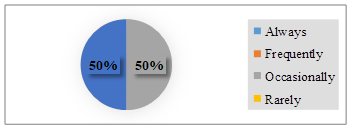 |
Question 2. Do you use gamified platforms in your English classes to improve reading comprehension?
Figure 2. Use of gamified platforms in English classes
Table 2. Use of gamified platforms in English classes
|
Alternative |
Frequency |
Percentage |
|
Always |
0 |
0% |
|
Frequently |
0 |
0% |
|
Occasionally |
2 |
50,00% |
|
Rarely |
0 |
0% |
|
Never |
2 |
50,00% |
The graph shows the responses to the question about gamified platforms in your English classes to improve reading comprehension. One teacher indicated that they use them occasionally (50%), while the other indicated that they never use them (50%). No responses were recorded for the options "always," "frequently," or "rarely." The result reflects limited use of gamified platforms in English classes. Only one of the teachers uses them occasionally, indicating little integration into teaching practice. It is recommended to promote their use through training and practical examples, given their potential to improve reading motivation and comprehension (Calderón, 2022).
 |
Question 3. Which of the following gamified platforms do you know or have used in your classes?
Figure 3. The most popular and widely used gamified platforms in classes
Table 3. The most popular and widely used gamified platforms in classes
|
Alternative |
Frequency |
Percentage |
|
Kahoot |
2 |
17,00% |
|
Quizizz |
2 |
17,00% |
|
Educaplay |
2 |
16,00% |
|
genially |
2 |
17,00% |
|
None |
2 |
16,00% |
The graph shows the responses to the question about which gamified platforms they are familiar with or have used in their classes. Of the four teachers surveyed, 50% stated they were familiar with or had used gamified platforms such as Kahoot, Quizizz, Educaplay, and Genially, while the other 50% indicated they had not used any. This result highlights a divide in the level of familiarity and use of gamified digital tools in the classroom. While some teachers are open to innovative methodologies, the other half have not yet incorporated these platforms, suggesting the need to strengthen teacher training in educational technologies to achieve a more equitable integration into the teaching-learning process (Fernández & Mayora, 2019).
 |
Question 4. Do you think gamified platforms improve students' participation in reading activities?
Figure 4. Gamified platforms improve student engagement
Table 4. Gamified platforms improve student engagement
|
Alternative |
Frequency |
Percentage |
|
Strongly agree |
3 |
75,00% |
|
Agree |
0 |
0% |
|
Neither agree nor disagree |
1 |
25,00% |
|
Disagree |
0 |
0% |
|
Strongly disagree |
0 |
0% |
The graph shows the responses to the question about whether gamified platforms improve student engagement in reading activities. Of the four teachers surveyed, 75% (3 teachers) strongly agreed that gamified platforms improve student engagement in reading activities, while the remaining 25% (1 teacher) remained neutral, expressing neither agreement nor disagreement. These results reflect a predominantly positive perception of the impact of gamified tools on student engagement. The absence of negative responses suggests that, while not all teachers hold a firm position (Sánchez, 2022).
 |
Question 5. How would you evaluate the impact of gamified platforms on improving your students' reading skills:
Figure 5. The impact of gamified platforms on student improvement
Table 5. The impact of gamified platforms on student improvement
|
Alternative |
Frequency |
Percentage |
|
Very high |
2 |
50,00% |
|
High |
1 |
25,00% |
|
Moderate |
1 |
25,00% |
|
Low |
0 |
0% |
|
None |
0 |
0% |
The graph shows the responses to the question about the impact of gamified platforms on improving students' reading skills. Of the four teachers surveyed, 50% (two teachers) considered the impact of gamified platforms on improving students' reading skills to be very high, while 25% (one teacher) rated it as high and the other 25% (one teacher) as moderate. No responses with "low" or "no" levels were recorded, indicating that all teachers perceived a positive effect, to varying degrees, of gamified platforms on reading development.
The survey revealed that only 50% of the participating teachers at Paján Public School are familiar with gamified reading platforms. This limited awareness suggests an absence of adequate training in digital methodologies and educational technology. According to (Britto et al., 2023), teacher familiarity and digital competence are crucial for the effective implementation of gamification strategies in language instruction.
Half of the teachers indicated that they occasionally use these platforms, while the remaining half have never implemented them. The most recognized platforms were Kahoot, Quizizz, Genially, and Educaplay, tools that are predominantly oriented toward general review and formative assessment, rather than reading comprehension. This aligns with Berrocal (2024), who emphasizes that the superficial use of digital tools without a targeted pedagogical purpose may limit their transformative potential in developing specific language skills.
Despite the low usage rates, 75% of the teachers agreed that gamified platforms significantly enhance student motivation and participation in reading activities. All surveyed teachers perceived a positive impact, ranging from moderate to very high, on reading comprehension skills. These perceptions support the findings of Sánchez (2022), who asserts that gamification, when effectively integrated, fosters engagement, autonomy, and cognitive involvement in language learning processes.
One of the most recurrent obstacles identified was the lack of technological infrastructure. Approximately 75% of the participants reported insufficient internet connectivity, absence of projectors, and lack of English or audiovisual laboratories. These structural deficiencies hinder equitable access to innovative methodologies, reinforcing the digital divide documented by González et al., (2023) in rural educational settings.
One of the most recurrent obstacles identified in the study was the limited availability of technological infrastructure within the educational context. Approximately 75% of the participants reported experiencing persistent difficulties related to inadequate internet connectivity, the absence of basic technological equipment such as projectors, and the lack of specialized English or audiovisual laboratories. These structural limitations significantly restrict the implementation of technology-mediated teaching strategies, particularly those that rely on digital platforms and interactive resources to enhance language learning.
The absence of adequate infrastructure not only constrains pedagogical innovation but also exacerbates existing educational inequalities, as students are deprived of opportunities to engage with digital tools that support differentiated instruction and autonomous learning. In this sense, the findings corroborate the digital divide described by González et al. (2023), who emphasize that rural educational settings often face systemic disadvantages in terms of access to technological resources, thereby limiting the effective integration of information and communication technologies (ICT) into instructional practices.
Moreover, insufficient infrastructure places an additional burden on teachers, who may possess the pedagogical knowledge to incorporate digital methodologies but lack the necessary gmaterial conditions for their implementation. Consequently, these deficiencies undermine efforts to modernize English language instruction and underscore the urgent need for institutional investment and policy interventions to ensure equitable access to technological resources across diverse educational contexts.
Opinions were split regarding students’ reading difficulties: 50% of teachers observed mild to severe comprehension issues, while the other 50% perceived relatively few challenges. This divergence indicates heterogeneous reading levels and highlights the need for differentiated instruction. Gamified platforms can address this variability by offering adaptive learning paths tailored to individual progress.
The results are consistent with previous academic studies that emphasize both the potential and limitations of gamification in language education. While the motivational benefits are widely acknowledged (Lina, 2024), the success of these platforms depends heavily on contextual factors such as teacher training, infrastructure, and strategic implementation (Quesada et al., 2021).
Conclusions
In conclusion, teachers should recognize and utilize various gamified reading platforms to improve reading comprehension in EFL students. The most frequently mentioned are ReadTheory, Raz-Kids, Epic! Quizziz and Reading Eggs, which integrate game elements such as scoring and immediate feedback to motivate students. These platforms are valued for their ability to adapt texts to students' levels and encourage independent reading.
Teachers face various challenges when promoting reading comprehension in EFL students. The main challenges include low vocabulary levels, poor reading habits, poor student motivation, and limited time to work with texts in-depth in the classroom. Furthermore, some teachers mentioned a lack of access to adequate resources and the challenge of finding materials that are engaging, accessible, and appropriate to the group's language proficiency level.
Teachers' opinions on the impact of gamified platforms on reading comprehension must be largely positive. Most agree that these tools increase motivation, promote active participation, and facilitate consistent reading practice, especially for students who lack interest in traditional texts. However, limitations were also noted, such as the superficiality of some content and the need for teacher support to ensure deep comprehension. In general, teachers consider these platforms useful, provided they are integrated in a planned manner and with clear pedagogical objectives.
References
Acevedo, G. L., & Castillo, M. L. (2023, diciembre 3). Gamificación para desarrollar comprensión lectora en el inglés de décimo grado. Gamificación para desarrollar comprensión lectora en el inglés de décimo grado.: https://hdl.handle.net/11323/12920
Barrios, E. M. (2023, Agosto 24). Motivación en el aula de lengua extranjera. chrome-extension://efaidnbmnnnibpcajpcglclefindmkaj/https://ebuah.uah.es/dspace/bitstream/handle/10017/917/Motivaci%C3%B3n%20en%20el%20Aula%20de%20Lengua%20Extranjera.pdf
Berrocal, O. C. (2024, Mayo 3). Fundamentos Teóricos sobre la Gamificación sin Recursos Digitales en el Fortalecimiento de la Inteligencia Lógico-Matemática. Ciencia Latina. https://doi.org/10.37811/cl_rcm.v8i2.10803
Bilbao, C. (2019, Noviembre 3). ¿Cómo el interés y la motivación influyen en el aprendizaje de una lengua extranjera? Revista interamericana de investigación, educación y pedagogía., 10(2), 25-36. ¿Cómo el interés y la motivación influyen en el aprendizaje de una lengua extranjera?: s://www.redalyc.org/journal/5610/561059354003/html/#:~:text=Aunque%20este%20hecho%20se%20puede%20explicar%20a%20través,y%20el%20posterior%20nivel%20de%20competencia%20en%20ésta.
Britto, J., Urraca, R. A., & Ferraz, J. (2023, agosto 3). The impact of digitalization on employment and skills by stages of adoption in Brazil and Argentina. Revista Brasileira. https://doi.org/10.20396/rbi.v22i00.8668456
Calderón, A. M. (2022, 2 28). Gamification in the reading comprehension of students in times of pandemic in Peru. Revista de Ciencias Sociales, 28(5), 63-74. Gamificación en la compresión lectora de los estudiantes: https://www.redalyc.org/journal/280/28071845005/html/
Castro, V. F. (2021, Julio 7). Motivación y esfuerzo en la adquisición de lenguas extranjeras. https://cvc.cervantes.es/ensenanza/biblioteca_ele/asele/pdf/25/25_0213.pdf
Fernández, N. Y., & Mayora, P. C. (2019, 9 11). Critical thinking and reading comprehension in a course of English as a foreign language. Íkala. https://doi.org/10.17533/udea.ikala.v20n1a06
Fernández, T. P. (2019, 8 1). El conocimiento lingüístico, temático y especializado previos en la comprensión lectora del inglés. Revista de la Asociación Europea de Lenguas para Fines Específicos, 5, 101-121. El conocimiento lingüístico, temático y especializado previos en la comprensión lectora del inglés: https://www.redalyc.org/articulo.oa?id=287026293007
Fraggioli, A. (2020, 1 1). Las Tecnologías de la información y la comunicación y su avance en el contexto educativo. Revista Metropolitana de Ciencias Aplicadas, 3(1), 94-101. LAS TECNOLOGÍAS DE LA INFORMACIÓN Y LA COMUNICACIÓN Y SU AVANCE EN EL CONTEXTO EDUCATIVO: https://www.redalyc.org/articulo.oa?id=721778104015
Gaitán, V. (2020, febrero 25). Gamificación: el aprendizaje divertido. Gamificación: el aprendizaje divertido: https://www.educativa.com/blog-articulos/gamificacion-el-aprendizaje-divertido/
González, P. D., Heredia, R., & Cuchillo, J. (2023, noviembre 23). Gamificación y Comprensión de Textos en Inglés en Estudiantes. Revista Tecnológica-Educativa Docentes 2.0, 16(2). https://doi.org/10.37843/rted.v16i2.434
Guarín, R. M. (2019, 11 10). Development of reading comprehension skills in English - as a foreign language - in fifth grade students. Revista Iberoamericana. https://doi.org/https://www.redalyc.org/journal/5610/561059354006/
Guarín, R. M., & Ramírez, R. M. (2019, 5 23). Desarrollo de habilidades de comprensión lectora en inglés -como lengua extranjera- en estudiante. https://doi.org/https://www.redalyc.org/journal/5610/561059354006/
Lina. (2024, 6 24). La estrategia de inferencia en la comprensión lectora. Estudio exploratorio en el contexto de la enseñanza del Español como Lengua Extranjera. La estrategia de inferencia en la comprensión lectora. Estudio exploratorio en el contexto de la enseñanza del Español como Lengua Extranjera: https://www.redalyc.org/journal/5858/585868284004/
Macedo, M. (2023, 9 18). Las plataformas como infraestructuras. El uso del enfoque infraestructural para estudiar dos tipos de plataformas no digitales. Ciencia Docencia y Tecnología. https://doi.org/10.33255/3469/1619
Martínez. (2019, 6 15). Usos marginales de los marcadores del discurso. Su efecto en la comprensión lectora en español. Usos marginales de los marcadores del discurso. Su efecto en la comprensión lectora en español: https://www.redalyc.org/articulo.oa?id=287026293004
Molina, G. P., Molina, G. A., & Gentry, J. L. (2023, JULIO 4). Gamification as a didactic strategy for learning the English language. Dominio de la Ciencias., 7(1), 722-730. https://doi.org/10.23857/dc.v7i1.1672
Ortiz, C. A. (2019, Agosto 8). Gamification in education: an overview on the state of the art. Educação e Pesquisa, 44, e173773. https://doi.org/10.1590/S1678-4634201844173773
Pérez, G. A., Raga, A. L., & García, A. Y. (2023, 3 24). La plataforma MOODLE como espacio para la acción orientadora. Revista Varela, 22(63), 181-190. La plataforma como espacio para la acción orientadora.: https://www.redalyc.org/articulo.oa?id=732280230002
Pignuoli, O. S. (2019, mayo 6). Digitalización y convergencia tecnológica. . Revista Electrónica Gestión de las Personas y Tecnología., 5(13). DIGITALIZACIÓN Y CONVERGENCIA TECNOLÓGICA DESDE EL PUNTO DE VISTA: https://www.redalyc.org/articulo.oa?id=477847114011
Quesada, L., Villavicencio, S., & Cathcart, M. (2021, 6 29). La estrategia de inferencia en la comprensión lectora. Estudio exploratorio en el contexto de la enseñanza del Español como Lengua Extranjera. Redufor. https://doi.org/10.25053/redufor.v6i2.4804
Quintero, C. M., Calderón, Z. M., & Trampuz, T. M. (2024, Noviembre 8). Gamificación y aprendizaje del idioma Inglés. REVISTA ALCANCE, 7(2), 69–80. https://doi.org/10.47230/ra.v7i2.81
Romero, F. (2022, 4 24). Lingüística, gramática y aprendizaje de lenguas extranjeras. Cuadernos de Lingüística Hispánica(19), 169-184. Lingüística, gramática y aprendizaje de lenguas extranjeras: https://www.redalyc.org/articulo.oa?id=322227527009
Sanchez, P. (2020, 7 29). Asociación de Televisión Educativa Iberoamericana (ATEI). Plataformas Comunicar., 16, 199-205. Plataformas: https://www.redalyc.org/articulo.oa?id=15801628
Sánchez, R. J. (2022, 8 13). Plataformas de enseñanza virtual para entornos educativos. Revista de Medios y Educación(34), 217-233. Plataformas de enseñanza virtual para entornos educativos: https://www.redalyc.org/articulo.oa?id=36812036015
Sany, M. L. (2022, junio 13). Gamificación para desarrollar la comprensión lectora del idioma Inglés. UCE-FIL-CPINEI. Gamificación para desarrollar la comprensión lectora del idioma Inglés: https://www.dspace.uce.edu.ec/entities/publication/4e0e711d-6c75-4961-8d6d-2af8bf11d7bd
Ushiña, C. M., Pazmiño, M. I., & Chiriboga, P. D. (2024, Junio 10). La Gamificación en el desarrollo de las habilidades lingüísticas del idioma inglés: Eficacia y estrategias educativas. Revista Pertinencia Académica, 8(3). La Gamificación en el desarrollo de las habilidades lingüísticas: file:///C:/Users/Usuario/Downloads/9_140_151_La+Gamificaci%C3%B3n+en+el+desarrollo+de+las+habilidades+ling%C3%BC%C3%ADsticas+del+idioma+ingl%C3%A9s.pdf
Ussa, Á. M. (2019, 5 4). Aprendizaje de lenguas extranjeras y su relación con el contexto. Cuadernos de Lingüística Hispánica(17), 107-116. Aprendizaje de lenguas extranjeras y su relación con el contexto: https://www.redalyc.org/articulo.oa?id=322227523009