Fecha de recibido: 03/05/2025
Fecha de aceptado: 20/07/2026
Fecha de publicado: 22/07/2026
Introduction
In higher education, English language teaching requires pedagogical approaches that respond to the demands of an increasingly globalized and constantly evolving context. Traditional methodologies, centered on the unidirectional transmission of knowledge, are insufficient to achieve deep and meaningful learning. In response to this challenge, active methodology strategies constitute an effective alternative, as they foster continuous student participation, promote learner autonomy, and strengthen communicative skills in authentic language-use contexts.
Strategies such as project-based learning, collaborative learning, experiential learning, and the use of interactive technologies transform students into active agents and protagonists of their own learning process. In the university setting, these methodologies not only enhance English language proficiency but also develop transversal competencies such as critical thinking, problem-solving, and effective communication. Their integration into the classroom is therefore essential for improving the quality of the teaching-learning process and preparing professionals capable of addressing the challenges of today's world.
Within the Ecuadorian context, many students face difficulties in developing effective communicative skills in English, despite the language becoming an increasingly important academic and professional requirement. This limitation is associated with the predominant use of grammar- and memorization-based teaching methods, which reduce students' active participation and provide limited opportunities for authentic interaction. Challenges such as low motivation, rote learning approaches, and insufficient communicative practice can be overcome through approaches that promote sustained engagement, the use of English in authentic contexts, and meaningful interaction between students and teachers.
The research problem guiding this study was formulated as follows: the low levels of reading comprehension and oral and written production demonstrated by many university students are exacerbated by the limited or inappropriate use of active methodological strategies, despite the fact that these strategies are fundamental for fostering classroom participation, critical thinking, creativity, and motivation. Consequently, the need arose to analyze how project-based learning, collaborative learning, and the use of interactive technologies can become effective tools for improving English language teaching and learning processes, as well as to identify current teaching practices, their strengths, and their limitations.
Background
Roy Sadradín et al. (2024) conducted a systematic review of the scientific literature published between 2017 and 2023, following the PRISMA guidelines and searching the Web of Science (WOS), Scopus, SciELO, and Google Scholar databases to examine how active methodologies are implemented in language teaching within Chilean higher education. The authors identified consistent patterns of positive student perceptions regarding both the effectiveness of these methodologies and the learning experience they provide. They also highlighted improvements in linguistic, cognitive, and social skills, as well as the ability of active methodologies to foster learner autonomy and create collaborative learning environments.
López-Hidalgo et al. (2025) carried out a literature review on the implementation of active methodologies in both virtual and face-to-face learning environments, considering their advantages, disadvantages, and conditions for implementation. They concluded that strategies such as project-based learning, task-based learning, the flipped classroom, and game-based learning promote learner autonomy, motivation, and communicative development, provided that appropriate instructional planning, teacher mediation, and continuous professional development are ensured.
Bolaños Robles et al. (2025) conducted a systematic review of studies published over the previous five years on the use of digital tools for English language learning among higher education students, aiming to determine how the combination of artificial intelligence, gamification, and active techniques contributes to improving the teaching-learning process. The authors concluded that these technologies not only enhance language acquisition but also enable students to manage their academic development in a more personalized manner. Furthermore, they emphasized that continuous teacher professional development is essential for the pedagogically reflective integration of these technologies.
Based on the perspectives of university faculty members, Idoiaga Mondragon et al. (2024) reported that active methodologies offer greater adaptability by enabling the design of curricular proposals aligned with students' interests while emphasizing competency-based learning, thereby strengthening social skills. From this perspective, the focus shifts from what the teacher does to what the student does.
Theoretical Foundations
Active methodology is a student-centered pedagogical approach that promotes participation, reflection, collaboration, and autonomy. Unlike the traditional model, in which the teacher transmits knowledge in a one-way manner, active methodology fosters dynamic and meaningful learning, where the teacher assumes the role of facilitator and guide. This approach is supported by three theoretical frameworks: constructivism, meaningful learning, and collaborative learning.
Constructivism, grounded in the theories of Piaget and Vygotsky, explains learning as an active and social process. Piaget describes how students construct knowledge through the assimilation and accommodation of mental schemas to achieve equilibrium with their environment, whereas Vygotsky emphasizes the role of the social and cultural context and highlights the Zone of Proximal Development, in which learning is enhanced through the guidance of an adult or peers. Both perspectives support active methodology by placing students at the center of their own learning process.
Meaningful learning is more effective when new knowledge is connected to learners' prior knowledge. Mystakidis (2021) stated that deep and meaningful learning involves higher-order thinking developed through active and diverse intellectual participation. Its purpose is the construction of meaning through pattern recognition and concept association, while incorporating inquiry, critical analysis, creativity, problem-solving, and metacognitive skills. Within active methodologies, this principle is implemented through debates, group projects, brainstorming activities, and case analysis.
Collaborative learning is based on group activities that require active participation and cooperation. A second-order meta-analysis conducted by Güngör et al. (2026) confirmed the positive effects of cooperative learning on academic achievement, higher-order thinking, and students' affective outcomes, thereby supporting its systematic integration into foreign language classrooms.
Active Strategies for English Language Teaching
Project-Based Learning (PBL) places students in situations where they are required to produce a real or simulated product in which language becomes a tool for investigating, creating, communicating, and presenting. In a systematic review of its application to English language teaching, Rohmah et al. (2024) documented improvements in communicative competence, motivation, and critical thinking, while also identifying challenges related to time management and assessment. Similarly, Guo et al. (2024) reviewed twenty-seven studies on Problem-Based Learning in English as a Foreign Language (EFL) contexts and reported positive effects on student behavior, academic achievement, and critical thinking.
The flipped classroom shifts theoretical content to pre-class learning through videos and readings, allowing face-to-face class time to be devoted to practice and the clarification of doubts. The meta-analysis conducted by Shahnama et al. (2021), which synthesized sixty-nine between-subject studies, found that the impact of the flipped classroom on student achievement was substantial and positive, and that its effectiveness increased when pre-class materials were supplemented with additional activities and exercises.
Gamification incorporates game mechanics into educational settings and is commonly supported by information and communication technologies (ICT). Huseinović (2023) reported positive effects of gamification on the motivation and academic performance of university students learning English as a foreign language. These strategies are complemented by role-playing, constructive dialogues, peer assessment, jigsaw reading, K-W-L graphic organizers, the think-pair-share technique, mingle activities, and Total Physical Response (TPR), all of which are designed to maximize the practice of the four macro language skills.
Educational technologies serve as a foundation for implementing these strategies. Rintaningrum (2023) synthesized the benefits and challenges of integrating technology into English language teaching and highlighted its potential to expand access to authentic learning materials and provide greater flexibility in learning pace. In the field of artificial intelligence, Du and Daniel (2024) reviewed the use of chatbots for speaking practice and emphasized their potential to provide immediate feedback and reduce communication anxiety, while also stressing the need for teacher mediation to ensure the quality of linguistic input.
Autonomous learning represents the culmination of this set of strategies. Chen (2023) found that learner autonomy is significantly associated with English language achievement among university students, with tolerance of ambiguity and foreign language classroom anxiety acting as mediating variables. These findings suggest that active methodologies enhance academic performance by strengthening self-regulation and reducing communicative inhibition
Objectives
The general objective of this study was to identify the importance of using active methodology strategies as a key tool for strengthening English language teaching and learning processes within the context of higher education in Ecuador.
The specific objectives were to: (a) analyze the effectiveness of active methodology strategies in the teaching and learning of English among university students; (b) propose an action plan for their systematic implementation in the classroom; and (c) develop an innovative pedagogical model that integrates these strategies.
Materials and Methods
This study adopted a quantitative approach with a descriptive scope and a cross-sectional, non-experimental research design to determine the relevance of using active methodology strategies as a tool for strengthening English language teaching and learning processes in Ecuadorian higher education. The research was complemented by a documentary literature review, which involved the identification, selection, and systematic analysis of indexed scientific publications published between 2021 and 2025 on active and participatory methodologies as strategies for enhancing the English language teaching and learning process.
Population and Sample
The study population consisted of students enrolled in the Pedagogía de los Idiomas Nacionales y Extranjeros program at the Universidad Estatal del Sur de Manabí. The sample comprised 32 second-semester students from Class “A”, selected through non-probability convenience sampling based on their accessibility and direct participation in the classroom experiences analyzed. Participation was voluntary, and the anonymity of all respondents was guaranteed.
Techniques and Instruments
Data were collected using an eight-item structured questionnaire administered through an online form. The questionnaire consisted of closed-ended items measured on a five-point Likert scale: strongly agree, agree, neutral, disagree, and strongly disagree. The items were designed to assess students' perceptions and level of agreement regarding three dimensions: the effectiveness of active methodology strategies, their impact on the development of communicative skills, and the motivation generated by innovative pedagogical models. In addition, the instrument examined students' perceptions of their learning progress compared with traditional teaching methods and the extent to which teaching practices were adapted to the needs of the group.
Data Processing
The responses were tabulated and analyzed using descriptive statistics, with the results expressed as relative frequencies (percentages) for each level of the Likert scale. Percentages were rounded to whole numbers; therefore, the total percentage for each item may differ slightly from 100%. The findings were presented graphically and interpreted considering the literature synthesized through the documentary analysis. This procedure made it possible to compare students' perceptions with the available empirical evidence and to provide support for both the proposed action plan and the pedagogical model.
Results and Discussion
The results of the survey administered to the 32 students are presented in Figure 1, which summarizes the percentage distribution of responses across the eight items included in the research instrument.
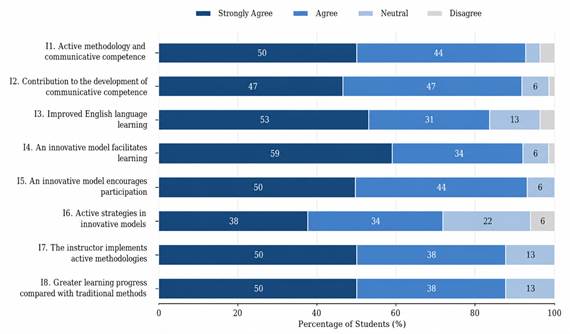 |
Figure 1. Students' Perceptions of the Use of Active Methodology Strategies in English Language Learning (n = 32)
Note. Data obtained from the online questionnaire administered to second-semester students enrolled in the Pedagogía de los Idiomas Nacionales y Extranjeros program. Prepared by the authors.
Regarding the relevance of active methodology for improving communicative competence in English within higher education, 50% of the students strongly agreed and 44% agreed, whereas 3% adopted a neutral position and another 3% disagreed. A similar pattern was observed in students' perceptions of the contribution of these methodologies to the development of communicative competence: 47% strongly agreed and 47% agreed, while 6% expressed a neutral opinion. Overall, 94% of the participants acknowledged the positive contribution of active methodologies, a finding consistent with the positive perceptions reported by Roy Sadradín et al. (2024) in Chilean higher education.
Regarding the improvement of English language learning attributed to the active methodologies implemented in class, 53% of the students strongly agreed and 31% agreed, whereas 13% remained neutral and 3% disagreed. The relatively higher proportion of neutral responses compared with the previous items suggests that language development, particularly listening and reading comprehension, requires more sustained and systematic exposure than can be achieved through occasional implementation. This interpretation is consistent with the findings of Shahnama et al. (2021), who reported that the effects of the flipped classroom increase when pre-class materials are complemented with additional learning activities.
With respect to the implementation of an innovative pedagogical model integrating active methodology strategies, 59% of the students strongly agreed and 34% agreed, while 6% remained neutral, representing the highest level of acceptance among all survey items. Similarly, 50% strongly agreed and 44% agreed that such a model encourages greater classroom participation. These findings support the conclusions of Huseinović (2023), who highlighted the positive effects of game-based and gamified strategies on student motivation in university English language classrooms.
The item concerning the integration of active strategies into innovative pedagogical models produced the highest level of uncertainty. Although 38% of the participants strongly agreed and 34% agreed, 22% expressed a neutral opinion and 6% disagreed. This variation may be explained by the prospective nature of the statement, which required students to evaluate a proposal that had not yet been fully implemented in practice. The literature provides a similar interpretation: Idoiaga Mondragon et al. (2024) argued that the successful adoption of active methodologies depends on institutional and professional conditions that are not always evident to students.
Regarding teaching practices, 50% of the respondents strongly agreed and 38% agreed that the instructor implements active methodologies adapted to the needs of the group, while 13% selected a neutral response. Finally, 50% strongly agreed and 38% agreed that they had made greater progress in English through active methodologies than through traditional teaching methods; 13% remained neutral and 3% disagreed. This perceived improvement is consistent with the empirical evidence synthesized by Guo et al. (2024) and Rohmah et al. (2024), who documented the positive effects of problem-based and project-based learning on the academic performance of English language learners.
Taken together, the eight survey items showed agreement levels exceeding 84%, whereas disagreement never exceeded 6%. These findings indicate a highly favorable perception of active methodologies among the students participating in this study. Nevertheless, it should be noted that the data reflect students' perceptions rather than objective measures of English language proficiency. Furthermore, the relatively small sample size and the use of non-probability convenience sampling limit the generalizability of the findings.
Action Plan for the Implementation of Active Methodology Strategies
Based on the findings of this study, an action plan was developed comprising four complementary lines of action aimed at ensuring the systematic, sustainable, and continuously improving implementation of active methodologies.
The first line of action focuses on continuous teacher training and professional development, with the objective of ensuring that instructors acquire the knowledge and skills necessary to effectively implement a variety of active methodologies. This line includes practical workshops on Project-Based Learning (PBL), Problem-Based Learning, the flipped classroom, gamification, and cooperative learning; professional development courses on technological tools for English language teaching; communities of practice for sharing experiences and teaching resources; and a peer observation system supported by constructive feedback. This proposal reflects the recommendations of López-Hidalgo et al. (2025) and Bolaños Robles et al. (2025), who emphasized the decisive role of continuous teacher professional development in the successful implementation of active methodologies.
The second line of action focuses on competency-based curriculum design, with the objective of explicitly integrating active methodologies into English language courses. It includes reviewing course syllabi to specify the methodologies to be implemented and their contribution to the intended learning outcomes; developing or selecting instructional resources such as case studies, simulations, projects, and role-playing activities; and designing assessment instruments capable of measuring the development of communicative competence through oral presentations, debates, written production, and real-time interaction.
The third line of action aims to promote active student participation in order to increase motivation and engagement. This includes the regular implementation of interactive activities such as debates, role-playing, oral presentations, group discussions, and collaborative problem-solving; the integration of interactive digital tools; the design of meaningful projects connected to authentic contexts and students' interests; and the promotion of collaborative learning environments in which English is practiced through mutual support and meaningful interaction.
The fourth line of action focuses on continuous assessment and feedback, with the objective of monitoring the effectiveness of active methodologies and adjusting instructional strategies whenever necessary. It includes the periodic administration of satisfaction surveys to both students and instructors, the analysis of the impact of active methodologies on language development and communicative competence, and the organization of focus groups to gain a deeper understanding of participants' experiences, perceptions, and recommendations.
Proposal of the Integrated Communicative-Active Model
The Integrated Communicative-Active Model prioritizes the integrated development of the four language skills—listening, speaking, reading, and writing—in an interconnected and contextualized manner. Students assume the central role in their own learning process, while the instructor serves as a facilitator and guide with specific responsibilities, including designing engaging and context-based learning activities, promoting participation and collaboration, providing timely and constructive feedback, adapting instructional methodologies to individual learning needs, and effectively integrating technology to enhance learning. The model is grounded in constructivism, experiential learning, connectivism, social interactionism, and the competency-based approach, the latter understood as an organizational framework rather than an educational philosophy.
The practical implementation of the model is organized into four sequential and interdependent phases, as illustrated in Figure 2.
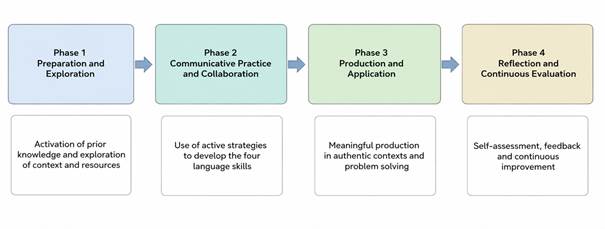
Figure 2. Implementation Phases of the Integrated Communicative-Active Model.
Note. Prepared by the authors.
The preparation and exploration phase takes place before class and is primarily based on the flipped classroom approach. Students engage with videos, readings, and podcasts to acquire fundamental concepts and grammatical knowledge, thereby freeing classroom time for interactive learning activities. The interactive and collaborative practice phase is carried out during class and integrates Project-Based Learning (PBL), Problem-Based Learning, cooperative learning, gamification, debates, and role-playing activities. During this phase, students apply English in authentic or simulated contexts while teamwork and continuous communication are actively encouraged.
The production and application phase extends learning beyond the classroom through individual or group projects that require the integrated use of the language. These activities include the creation of blogs, podcasts, and videos, oral presentations, professional scenario simulations, and language exchange experiences. Finally, the reflection and feedback phase provides continuous opportunities for formative feedback from both instructors and peers while promoting self-assessment and peer assessment as mechanisms for fostering self-regulated learning. This final phase is particularly relevant in light of the findings reported by Chen (2023), who identified a significant relationship between learner autonomy, classroom anxiety, and English language achievement.
Conclusions
The survey findings revealed strong student support for the implementation of active methodologies in English language teaching within higher education. Overall, 94% of the participants recognized that these methodologies contribute to the development of communicative competence, 93% expressed a positive evaluation of an innovative pedagogical model integrating active methodologies, and 88% perceived greater learning progress than that achieved through traditional teaching methods. These findings confirm the relevance of active methodologies as an effective approach for strengthening English language teaching and learning processes.
The proposed action plan outlines concrete steps for transforming English language teaching in higher education through four interconnected lines of action: continuous teacher professional development, competency-based curriculum adaptation, the promotion of active student participation, and continuous assessment accompanied by constructive feedback. Their integrated implementation enables the systematic adoption of active methodologies, ensures appropriate institutional support, and promotes continuous improvement.
The Integrated Communicative-Active Model provides the pedagogical framework that organizes these strategies into four sequential phases. Grounded in constructivism, experiential learning, connectivism, and social interactionism, the model places students at the center of the learning process and promotes the active construction of knowledge through interaction, practical experience, and meaningful connections with authentic contexts, while redefining the instructor's role as a facilitator and designer of learning experiences.
Future research should further investigate the implementation of active methodologies across different educational contexts and examine their long-term impact through experimental research designs and probability sampling techniques capable of overcoming the limitations of the present study. In addition, teacher professional development should extend beyond isolated workshops and evolve into a comprehensive program incorporating mentoring, classroom observation, co-teaching, and individualized feedback. It is also recommended that data be collected on a regular basis through surveys, focus groups, academic performance indicators, and classroom observations to support the continuous refinement of both the proposed action plan and the Integrated Communicative-Active Model.
References
Bolaños Robles, M. L., Soria Martínez, D. A., Domínguez Viteri, A. F., Condoy Panchi, L. A., & Tirira Viana, V. N. (2025). IA, gamificación y aprendizaje activo en la enseñanza del inglés: en busca de un aprendizaje motivador y eficaz. Revista Social Fronteriza, 5(2), e675. https://doi.org/10.59814/resofro.2025.5(2)675
Chen, L. (2023). Learner autonomy and English achievement in Chinese EFL undergraduates: The mediating role of ambiguity tolerance and foreign language classroom anxiety. Language Learning in Higher Education, 13(1), 295–308. https://doi.org/10.1515/cercles-2023-2001
Du, J., & Daniel, B. K. (2024). Transforming language education: A systematic review of AI-powered chatbots for English as a foreign language speaking practice. Computers and Education: Artificial Intelligence, 6, 100230. https://doi.org/10.1016/j.caeai.2024.100230
Güngör, F., Altunbaşak, İ., Aydın, A. T., Kaya, M., & Erdem, C. (2026). A second-order meta-analysis on the effects of cooperative learning on students’ academic achievement, higher-order thinking, and affective behaviors. Current Psychology, 45(6). https://doi.org/10.1007/s12144-025-08943-0
Guo, Q., Jamil, H., Ismail, L., Luo, S., & Sun, Z. (2024). Effects of problem-based learning on EFL learning: A systematic review. PLOS ONE, 19(12), e0307819. https://doi.org/10.1371/journal.pone.0307819
Huseinović, L. (2023). The effects of gamification on student motivation and achievement in learning English as a foreign language in higher education. MAP Education and Humanities, 4(1), 10–36. https://doi.org/10.53880/2744-2373.2023.4.10
Idoiaga Mondragon, N., Beloki, N., Yarritu, I., Zarrazquin, I., & Artano, K. (2024). Active methodologies in higher education: Reasons to use them (or not) from the voices of faculty teaching staff. Higher Education, 88(3), 919–937. https://doi.org/10.1007/s10734-023-01149-y
López-Hidalgo, D. B., Mazo-Atiaja, A. P., & Flores-Ubidia, J. L. (2025). Enseñanza del inglés mediante metodologías activas en entornos virtuales y presenciales. MQRInvestigar, 9(2), e478. https://doi.org/10.56048/MQR20225.9.2.2025.e478
Mystakidis, S. (2021). Deep meaningful learning. Encyclopedia, 1(3), 988–997. https://doi.org/10.3390/encyclopedia1030075
Rintaningrum, R. (2023). Technology integration in English language teaching and learning: Benefits and challenges. Cogent Education, 10(1), 2164690. https://doi.org/10.1080/2331186X.2022.2164690
Rohmah, N., Rosyidha, A., & Dwi Eko Saputri, L. A. (2024). Unlocking the potential of project-based learning in English language education: A systematic review of benefits, challenges, and implementation strategies. Journal of English Language Teaching and Applied Linguistics, 6(4), 161–167. https://doi.org/10.32996/jeltal.2024.6.4.17
Roy Sadradín, D., Céspedes-Carreño, C., & Vera Carreño, H. (2024). Active methodologies used in language teaching in Chilean college education: A systematic revision. Porta Linguarum, (XI), 11–24. https://doi.org/10.30827/portalin.viXI.30028
Shahnama, M., Ghonsooly, B., & Shirvan, M. E. (2021). A meta-analysis of relative effectiveness of flipped learning in English as second/foreign language research. Educational Technology Research and Development, 69(3), 1355–1386. https://doi.org/10.1007/s11423-021-09996-1