Fecha de recibido: 21/11/2025
Fecha de aceptado: 29/01/2026
Fecha de publicado: 09/02/2026
Introduction
In recent decades, English has consolidated its position as a global language for academic, professional, and intercultural communication. Consequently, higher education institutions increasingly prioritize the development of communicative competence in English, with particular emphasis on oral expression as a core learning outcome. Oral communication is widely regarded as one of the most demanding language skills, as it requires the simultaneous integration of linguistic knowledge, cognitive processing, and affective regulation. In EFL university classrooms, students are often expected to communicate orally despite limited proficiency, which can intensify emotional responses during language use (Jugo, 2020).
Within this context, affective variables have gained sustained attention in research on English as a Foreign Language (EFL). Among these variables, communicative anxiety, commonly referred to as speaking anxiety or oral communication anxiety, has been consistently identified as a factor that may limit students’ willingness to participate in oral tasks and engage in classroom interaction. Rather than reflecting a simple lack of linguistic competence, communicative anxiety in EFL settings represents a complex emotional response linked to fear of negative evaluation, reduced self-confidence, and apprehension when using English in front of others, particularly in university contexts where oral performance is often associated with academic assessment (Alhahidh & Altalhab, 2020; Hasibuan et al., 2020).
At the meso level, a growing body of empirical research conducted in higher education EFL contexts has examined the relationship between communicative anxiety and oral expression. While many studies report a negative association between anxiety and speaking performance, the strength and nature of this relationship vary across educational settings, research designs, and measurement instruments. Differences in methodological approaches, sample characteristics, and assessment tools have contributed to a fragmented body of findings, making it difficult to draw consistent conclusions from individual studies (Jugo, 2020; Hasibuan et al., 2020).
At the micro level, despite the growing body of empirical research, there is a lack of systematic syntheses that organize and critically examine the available evidence on this topic from an educational perspective. Existing reviews often adopt broad affective frameworks or include diverse language skills, without focusing specifically on oral expression in higher education. This gap highlights the need for a systematic review that identifies and describes how communicative anxiety has been conceptualized, measured, and related to oral performance in empirical studies involving university students.
Therefore, the purpose of this systematic review is to analyze the scientific evidence reported in empirical studies on the relationship between communicative anxiety and oral performance in English among university students. Specifically, this review aims to identify the main theoretical approaches adopted in the literature and to describe the research methods and instruments used to examine this relationship. By synthesizing recent empirical findings, this study seeks to contribute to a clearer understanding of communicative anxiety in university EFL contexts and to inform future research and pedagogical practices.
Materials and methods
Research Design
This study adopted a systematic review design to synthesize empirical evidence on the relationship between communicative anxiety and oral English performance among university students. This approach was chosen to ensure transparency, methodological, rigor, and replicability throughout the review process. The review was conducted in accordance with the Preferred Reporting Items for Systematic Reviews and Meta-Analyses (PRISMA) 2020 guidelines, which provide a structured framework for the identification, screening, eligibility assessment, and inclusion of studies (Page et al., 2021).
Research Question
The systematic review was guided by the following research question:
What evidence do empirical studies report on the relationship between communicative anxiety and oral performance in English among university students?
Search Strategy
A systematic literature search was carried out in four electronic databases widely used in educational and applied linguistics research: Scopus, ERIC, Redalyc, and Google Scholar. These databases were selected due to their broad coverage of peer-reviewed studies in the fields of education and English as a Foreign Language (EFL). The search included articles published between 2020 and 2025 and written in English.
Search terms were defined by combining keywords related to communicative anxiety and oral performance using Boolean operators (AND, OR). The main search terms included communicative anxiety, foreign language anxiety, oral expression, speaking performance, English as a foreign language, and university students.
Eligibility Criteria
Clear inclusion and exclusion criteria were established prior to the screening process in order to ensure consistency in study selection.
Inclusion criteria:
· Empirical studies examining communicative anxiety in relation to oral performance in English.
· Studies conducted with university-level students.
· Articles published between 2020 and 2025.
· Publications written in English.
· Full-text availability.
Exclusion Criteria:
· Studies with a clinical, diagnostic, or therapeutic focus on anxiety.
· Research conducted at non-university educational levels.
· Publications written in languages other than English.
· Document types other than empirical research articles (e.g., literature reviews, theses, book chapters, or editorials).
· Studies that did not address the relationship between communicative anxiety and oral performance.
Study Selection Process
The study selection process followed the PRISMA 2020 guidelines. Initially, 150 records were identified through database searches. Titles and abstracts were screened to assess relevance, resulting in 30 articles selected for full text review. After applying the inclusion and exclusion criteria, 21 empirical studies were included in the final review. No duplicate records were identified during the selection process.
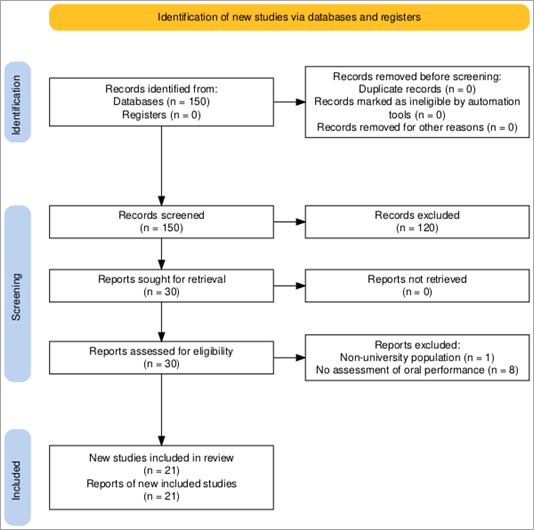 |
The flow of study identification, screening, eligibility, and inclusion is summarized in the PRISMA flow diagram (Figure 1).
Figure 1. PRISMA flow diagram of the study selection process.
Data Extraction
Data extraction was conducted using a structured extraction table specifically designed for the review. The table was used to systematically collect key information from each selected study, including authors and year of publication, country or research context, study objectives, methodological design, sample characteristics, instruments used to measure communicative anxiety, instruments used to assess oral performance, main findings related to anxiety and oral expression, the relationship reported between these variables, and limitations identified by the authors.
The complete data extraction framework is presented in Table 1, which summarizes the empirical studies included in the systematic review.
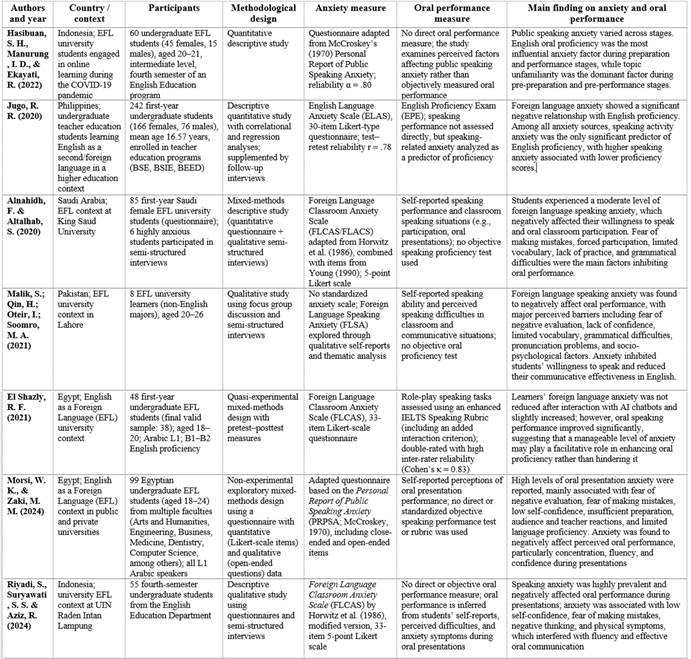
Table 1. Summary of the empirical studies included
in the systematic review

Only information explicitly reported in the original articles was extracted. No reinterpretation or reanalysis of the original data was performed.
Quality Considerations
While a formal quality appraisal checklist was not employed, careful consideration was given to key methodological aspects such as research design, sample size, instrument validity, and clarity of reporting. This allowed for a thoughtful evaluation of the robustness of the evidence included in the review. In line with its descriptive scope, the review did not use quality scores as a criterion for exclusion.
Data Analysis
A descriptive and thematic synthesis approach was used to analyze the extracted data. Studies were compared and organized to identify recurring patterns in theoretical approaches, methodological designs, research instruments, and reported relationships between communicative anxiety and oral performance. The analysis focused on describing trends rather than estimating effect sizes, in line with the objectives of the review.
Ethical Considerations
As this study was based solely on previously published research, it did not involve direct interaction with human participants. Therefore, ethical approval was not required.
Results and discussion
Overview of the selected studies
A total of 21 empirical studies met the established inclusion criteria and were included in this systematic review. All selected articles were published between 2020 and 2025 and examined communicative anxiety in relation to oral performance in English among university students. The studies were conducted in higher education contexts where English was taught as a foreign language, and full-text versions were available for all included articles.
The selected studies addressed communicative anxiety as an educational and affective variable within English as a Foreign Language (EFL) learning environments. None of the studies adopted a clinical or therapeutic perspective, and all focused on learners enrolled in undergraduate level English courses.
Geographical and contextual distribution
The included studies were carried out in a range of geographical contexts, reflecting the examination of communicative anxiety in diverse university EFL settings. Research was conducted in higher education institutions across different regions, including Asia, Latin America, the Middle East, and Europe. In all cases, English functioned as a foreign language within the instructional context, rather than as a second or native language.
Across these contexts, the studies examined communicative anxiety in classroom-based environments, such as regular EFL courses, speaking focused classes, or oral communication components within broader language programs.
Methodological characteristics of the studies
With regard to research design, most of the reviewed studies employed quantitative methodologies, predominantly using correlational or descriptive designs to examine the relationship between communicative anxiety and oral performance. A smaller number of studies adopted mixed methods approaches, combining quantitative data with qualitative information obtained through interviews, classroom observations, or open-ended questionnaires. Qualitative only designs were less frequently represented.
Sample sizes varied across studies, ranging from relatively small classroom-based groups to larger cohorts of university students. In all cases, participants were enrolled in higher education institutions and were identified as learners of English as a foreign language. Data collection was conducted within academic settings and aligned with instructional activities related to oral communication.
Instruments used to measure communicative anxiety
Communicative anxiety was assessed primarily through self-report questionnaires. The Foreign Language Classroom Anxiety Scale (FLCAS) was the most frequently reported instrument across the reviewed studies, either in its original version or in adapted forms focusing specifically on speaking or oral communication anxiety. Several studies reported modifications to existing scales in order to better fit their educational contexts or research objectives.
In addition to standardized questionnaires, a limited number of studies incorporated qualitative tools, such as interviews or reflective journals, to gather supplementary information about students’ experiences of anxiety during oral communication tasks. All instruments were used within non-clinical, educational research frameworks.
Instruments used to assess oral performance
Oral performance in English was evaluated using a variety of assessment methods. Commonly reported approaches included oral tests, structured speaking tasks, classroom presentations, role plays, and instructor rated speaking activities. Many studies employed analytic or holistic scoring rubrics that considered dimensions such as fluency, pronunciation, grammatical accuracy, vocabulary use, and overall communicative effectiveness.
In some cases, oral performance was measured using course based speaking scores assigned by instructors, while other studies relied on researcher-developed assessment tools. A smaller number of studies combined performance-based assessments with self-reported measures of speaking ability. All assessments were conducted within instructional contexts and were directly related to university level EFL coursework.
Reported relationship between communicative anxiety and oral performance
All included studies explicitly examined the relationship between communicative anxiety and oral performance in English. The majority of the studies reported an association in which higher levels of communicative anxiety were linked to lower levels of oral performance, as reflected in speaking scores, performance ratings, or self-reported speaking competence. Several studies reported statistically significant correlations between these variables.
Other studies described this relationship using qualitative or descriptive data, indicating that communicative anxiety was associated with aspects of oral communication such as participation in speaking activities, fluency during oral tasks, and willingness to engage in classroom interaction. Across the reviewed studies, relationships were reported as associations based on empirical data, and no study claimed a causal link between communicative anxiety and oral performance.
Discussion
This systematic review examined empirical evidence on the relationship between communicative anxiety and oral English performance among university students in EFL contexts. Overall, the reviewed studies consistently conceptualized communicative anxiety as an affective variable embedded in classroom interaction rather than as a clinical condition, reinforcing its relevance within educational research. Across diverse higher education settings, communicative anxiety particularly speaking-related anxiety was repeatedly associated with students’ oral performance, participation, and engagement in English speaking tasks.
One of the most evident trends identified in the literature is the predominance of quantitative research designs, especially descriptive and correlational studies. Many of the reviewed studies relied on statistical analyses to explore the association between anxiety levels and speaking performance, reporting negative relationships of varying strength (Jugo, 2020; Hasibuan et al., 2022). While these designs provide valuable insights into measurable relationships between variables, they offer limited access to learners’ subjective experiences of anxiety during oral communication. In contrast, a smaller number of qualitative and mixed-methods studies highlighted the contextual and experiential dimensions of speaking anxiety, illustrating how psychological, social, and classroom-related factors contribute to students’ apprehension when speaking English (Alnahidh & Altalhab, 2020; Malik et al., 2021). These findings suggest that future research may benefit from greater methodological diversification to capture both quantifiable outcomes and lived experiences.
The analysis also revealed a high degree of consistency in the instruments used to measure communicative anxiety. The Foreign Language Classroom Anxiety Scale (FLCAS) and its adapted versions were the most frequently employed tools across the reviewed studies (Alnahidh & Altalhab, 2020; El Shazly, 2021). The widespread use of this scale facilitates comparison across different educational contexts and reaffirms its established relevance in EFL research. However, several studies reported contextual adaptations or the use of complementary qualitative tools, underscoring the influence of institutional, cultural, and instructional factors on how communicative anxiety manifests in university classrooms.
In contrast, the assessment of oral performance displayed greater methodological variability. The reviewed studies employed a wide range of evaluation methods, including oral tests, classroom presentations, speaking rubrics, teacher-assigned scores, and task-based assessments (Hasibuan et al., 2022; El Shazly, 2021). While this diversity reflects the multifaceted nature of oral communication in EFL contexts, it also complicates direct comparisons across studies. Differences in assessment criteria, task formats, and scoring procedures may partially explain the variation observed in the reported strength of the relationship between communicative anxiety and oral performance.
Despite these methodological differences, the evidence synthesized in this review points to a generally negative association between communicative anxiety and oral English performance. Several studies reported that higher anxiety levels were linked to lower speaking scores, reduced fluency, and a decreased willingness to participate in oral activities (Jugo, 2020; Hasibuan et al., 2022). Other studies emphasized the influence of anxiety on learners’ classroom behavior, including the avoidance of speaking opportunities and an increased fear of negative evaluation (Malik et al., 2021). Importantly, none of the reviewed studies claimed causal relationships; instead, their findings were framed as associations grounded in empirical observation.
Finally, the review literature reveals recurring limitations that should be considered when interpreting these findings. Many studies relied heavily on self-report measures of anxiety, which may reflect learners’ perceptions rather than observable performance alone (Alnahidh & Altalhab, 2020). Additionally, small or context-specific samples, along with the concentration of studies in particular regions, may limit the transferability of results to other EFL settings (Malik et al., 2021). These limitations highlight the need for future research incorporating longitudinal designs, multiple sources of data, and pedagogically grounded approaches to better understand how communicative anxiety interacts with oral performance in university EFL classrooms.
Conclusions
This systematic review synthesized empirical evidence published between 2020 and 2025 on the relationship between communicative anxiety and oral English performance among university students. The reviewed studies consistently identify communicative anxiety as a relevant affective variable associated with learners’ performance and engagement in oral communication tasks within EFL contexts. Across different educational settings, higher levels of anxiety are commonly reported alongside lower levels of speaking performance, reduced classroom participation, and greater reluctance to engage in oral activities.
The findings also reveal clear methodological patterns in the existing literature. Most studies adopt quantitative and correlational designs and rely on standardized self-report instruments to measure communicative anxiety, often complemented by performance-based assessments of speaking. While these approaches have contributed to a clearer empirical description of the relationship between anxiety and oral performance, they also highlight limitations related to contextual variation, reliance on self-reported data, and restricted methodological diversity.
From an educational perspective, the evidence reviewed suggests that communicative anxiety should be understood as an integral component of the university EFL learning experience rather than as an isolated or clinical phenomenon. Classroom conditions, assessment practices, and opportunities for meaningful oral interaction appear to be closely intertwined with students’ emotional responses to speaking in English. Addressing communicative anxiety within pedagogical planning may therefore support more inclusive and supportive learning environments that facilitate oral participation.
Finally, this review highlights the need for future research that expands methodological approaches through longitudinal, qualitative, and mixed-methods designs. Further studies are also needed to explore pedagogically grounded strategies aimed at addressing communicative anxiety in higher education contexts. Such research may contribute to a more nuanced understanding of how affective factors interact with oral language development and help inform more effective instructional practices in university EFL classrooms.
References
Haddaway, N. R., Page, M. J., Pritchard, C. C., & McGuinness, L. A. (2022). PRISMA2020: An R package and Shiny app for producing PRISMA 2020-compliant flow diagrams, with interactivity for optimised digital transparency and Open Synthesis Campbell Systematic Reviews, 18, e1230. https://doi.org/10.1002/cl2.1230
Hasibuan, S. H., Manurung, I. D., & Ekayati, R. (2022). Investigating Public Speaking Anxiety Factors among EFL University Students through Online Learning. Applied Research on English Language, 11(1), 21–38. https://doi.org/10.22108/are.2021.130092.1767
Jugo, R. R. (2020). Language Anxiety in Focus: The Case of Filipino Undergraduate Teacher Education Learners. Education Research International, 2020. https://doi.org/10.1155/2020/7049837
Alnahidh, F., Altalhab, S., & Author, C. (n.d.). The Level and Sources of Foreign Language Speaking Anxiety among Saudi EFL University Students. https://doi.org/10.7575/aiac.alls.v.11n.1-p.55
Malik, S., Qin, H., Arif Soomro, M., & Oteir, I. (2021). Detecting Perceived Barriers in FLSA: The Socio-Psycholinguistic Study of EFL University Learners. Advances in Language and Literary Studies, 12(1), 34. https://doi.org/10.7575/aiac.alls.v.12n.1.p.34
El Shazly, R. (2021). Effects of artificial intelligence on English speaking anxiety and speaking performance: A case study. Expert Systems, 38(3). https://doi.org/10.1111/exsy.12667
Morsi, W. K., & Zaki, M. M. (2024). Oral Presentations’ Anxiety among Egyptian Undergraduates: Causes and Remedies. IJELTAL (Indonesian Journal of English Language Teaching and Applied Linguistics), 9(2), 425. https://doi.org/10.21093/ijeltal.v9i2.1705
Riyadi, S., Suryawati, S. S., & Aziz, R. (2024). Students’ Anxiety in Oral Presentations: Factors and Strategies at UIN Raden Intan Lampung. IJLHE: International Journal of Language, Humanities, and Education, 7(2), 283–294. https://doi.org/10.52217/ijlhe.v7i2.1620
Estrella, F. (2022). Determining Ecuadorian Undergraduate English Polytechnic Students’ Speaking Anxiety While Making Presentations in Virtual Environments During COVID-19. Journal of Advanced Research in Education, 1(2), 1–21. https://doi.org/10.56397/jare.2022.12.01
Radić-Bojanić, B., & Topalov, J. (2021). Anxiety in academic speaking situations among EFL majors: A case study. Language Learning in Higher Education, 11(1), 115–132. https://doi.org/10.1515/cercles-2021-2017
Quvanch, Z., Qasemi, A. S., & Na, K. S. (2024). Analyzing levels, factors and coping strategies of speaking anxiety among EFL undergraduates in Afghanistan. Cogent Education, 11(1). https://doi.org/10.1080/2331186X.2024.2413225
Bravo Bailón, M. D., Santana Bailón, A. M., Bello Piguave, J., & Villafuerte Holguín, J. (2025). Emotional factors and their influence on speaking performance in university students. LATAM Revista Latinoamericana de Ciencias Sociales y Humanidades, 6(4). https://doi.org/10.56712/latam.v6i4.4477
Hermagustiana, I., Astuti, A. D., & Sucahyo, D. (2021). Do I Speak Anxiously? A Correlation of Self-Efficacy, Foreign Language Learning Anxiety and Speaking Performance of Indonesian EFL Learners. Script Journal: Journal of Linguistics and English Teaching, 6(1), 68–80. https://doi.org/10.24903/sj.v6i1.696
Malik, S., Oteir, I., & Alotaibi, A. N. (2024). An empirical investigation of the relationship between individual learner factors and foreign language speaking anxiety in EFL university learners. International Journal of Innovative Research and Scientific Studies, 7(2), 674–689. https://doi.org/10.53894/ijirss.v7i2.2863
Mohammed Ibrahim, R., & Yahya HamadAmin, L. (2021). Students: A Case Study at a Public University. In Al-Ustath Journal for Human and Social Sciences (Vol. 60, Issue 1).
Alharbi, A. T. (2021). Speaking anxiety during English oral presentations. Linguistics and Culture Review, 5(S2), 1548–1564. https://doi.org/10.21744/lingcure.v5ns2.2214
AbuSahyon, A. S. E., Almukhales, R. A., Makhashen, S. S., & AlHarthi, R. E. (2023). The Effect of Speaking Anxiety on EFL Saudi Learners’ Performance. International Journal of Membrane Science and Technology, 10(3), 3212–3222. https://doi.org/10.15379/ijmst.v10i3.3233
Mouhoubi-Messadh, C., & Khaldi, K. (2022). Dealing with foreign language speaking anxiety: What every language teacher should know. Training, Language and Culture, 6(1), 20–32. https://doi.org/10.22363/2521-442X-2022-6-1-20-32
Lin, S. (2023). Examining Factors of Speaking Anxiety among Chinese EFL Students in Higher Education. In Journal of Education, Humanities and Social Sciences MAMEE (Vol. 2023).
Daymiel, R. J., CANTINA, J., Alipoyo, V. R. I., Comecilla, M. O., Patay, A. S., & Recamara, J. T. (2022). Anxiety in Second Language in Relation to Students’ Speaking Performance. Sprin Journal of Arts, Humanities and Social Sciences, 396–410. https://doi.org/10.55559/sjahss.v1i08.41
Widia Utari, L., Salam, U., Ikhsanudin, I., & Rosnija, E. (2022). SPEAKING ANXIETY IN ORAL PRESENTATION OF EFL STUDENTS. In Salam, Ikhsanudin, Rosnija / JEFLE (Vol. 3, Issue 2).
Rachmawati, D. I., & Jurianto, J. (2020). Investigating English department students’ foreign language speaking anxiety: a case study in universitas Airlangga, Indonesia. Social Sciences, Humanities and Education Journal (SHE Journal), 1(2), 22. https://doi.org/10.25273/she.v1i2.6624