Fecha de recibido: 16/11/2025
Fecha de aceptado: 29/01/2026
Fecha de publicado: 09/02/2026
Introduction
Morphology examines the internal structure of words and the principles that govern their formation through meaningful units such as roots, prefixes, and suffixes. This linguistic component is central to accurate writing because it supports grammatical precision and lexical clarity in written communication. In Ecuador, university learners of English as a foreign language (EFL) frequently experience persistent difficulties when producing short paragraphs and brief sentences, where errors commonly involve omission, addition, substitution, and misspelling (Haspelmath, 2002). Such inaccuracies reduce comprehensibility and weaken the coherence of academic writing, even when learners can communicate basic ideas.
Learning English as a foreign language entails the cultivation of various interconnected dimensions of language development including grammar, vocabulary, and writing, which is a strong indicative of all the aforementioned dimensions. In the course of this cultivation, the various types of morphemes, especially inflectional and derivational, present a major obstacle at all levels of proficiency, as learners are expected to choose and apply the appropriate morphemes, all under the constraining factors of time and attention (Nordquist, 2020). Furthermore, there is a need to draw the line between EFL and ESL/EAL contexts where English is widely available, and the varying conditions of exposure are different and have an impact on the conditions of practice and feedback. In the context of EFL, the scarce input and the absence of genuine communicative situations magnifies the impact of the lacking proficiency in the area of morphology on the writing skills of learners.
Several studies point to the errors of morphology as being present in all the writing systems and are prone to disappear during the course of writing in a spontaneous manner, and that it is not the result of an artificial task. Other studies show that a good number of the mistakes made by learners are not mere approximations at the phonic level, but are attempts to construct and encode a meaningful form in a second or foreign language. In Ecuador, the context in which we work, teachers see the same morphologic and spelling errors many times in student work, and assessments, a clear signal that this is a structural problem, not a random one (Larionova and Martynova, 2022). This is in line with the current literature that considers the issue of morphologic accuracy a constant struggle in EFL writing.
A risk factor for this problem situation may be the inefficiency of some schools' English instruction, where the teaching practice may focus on word-by-word translation from Spanish to English. Learners may think that correct writing is achieved by simply substituting Spanish words for English ones, and because of this, they may disregard the differences between the two languages regarding word formation and inflection. The opportunities to interact with authentic English texts, lack of explicit and systematic instruction in morphological awareness, and lack of self-regulation in writing may be the explanations for the students' lack internalization of the rules of the English language. The above factors indicate that learners are likely to produce words in the incorrect form, misuse the plural, lack inflectional endings, and create unsystematic derivational forms.
Mistakes are multi-faceted and can have formal repercussions. Mistakes concerning morphology can negatively impact meaning, clarity, and the resultant performance of students, as seen in the case of the feedback provided. This context, and the persistence of such errors, even at the primary and intermediate EFL levels, calls for unpacking, in greater depth, the reason for the absence of morphologically accurate constructions, regardless of the extensive English instruction undertaken. Error analysis research is plentiful; however, the majority has been concerned with large scale compositions, such as essays and reports. The research concerning the analysis of short, controlled, paragraph writing tasks is limited. These tasks are commonplace in teaching, and are even employed as evaluative measures, and are exemplars of the repeating patterns practice. Therefore, they are more informative than other practice types as they address morpho-automatic control.
The focus of this study can be justified particularly in comparison to other studies in the field that employ various other methodologies. The study cites the case of EFL learners, typifying the case of writing as one of the problems to be assessed, and constraining the analysis to the case of grammar and morphology of the constructs. Also, EFL learners and writers exemplify the use of the error taxonomy at the levels of omissions, additions, and other constructs attributed to interlanguage, the shallow rule, and focus. Such errors are evident in EFL writers. The studies lend support to the belief that such a phenomenon can be analyzed, and the analysis can be relevant, and more importantly, constructive and pedagogically beneficial to the learner. In this study, it may be justified to state that a combination of cross-linguistic interference and scant instruction on writing EFL short paragraphs in Ecuador accounts for the presence of some of the predictable errors.
Thus, this research seeks to provide an answer to the question, what are the most common types of morphological mistakes EFL learners commit while writing short paragraphs? More specifically, the current study seeks to describe the most apparent morphological errors committed by Ecuadorian learners of English as a foreign language at the university level. Justification of the need to carry out this study lies in the fact that it aids practitioners in identifying the most neglected areas of the morphologic spectrum that need instructional/practical improvement and provides Ecuadorian practitioners with a more focused evaluative perspective on casework by describing the most frequent errors and correlating them to the cognitive objectives targeted at Ecuadorian learners.
Because it is a study that makes a case of a qualitative descriptor focused on the study of EFL learners, it places morphological errors in writing short paragraphs on Ecuadorian university students. This involves a guided writing activity comprising sentence-level exercises and a short paragraph, a collection of written texts, and an analytic checklist. The data are classified, analyzed, and discussed with regard to the instructional and linguistic concerns related to each error.
Scientific and technical foundation
Background
According to previous studies, these are the most common morphological errors:
Error Analysis in EFL Students’ Writing Skill. Seddik (2023) examined writing errors in twenty Egyptian first-year students of English as a foreign language (EFL) using a mixed-methods approach. The study aimed to understand L2 acquisition by identifying, linguistically explaining, and investigating the causes of errors. Semi-structured interviews and writing tasks were used to collect data. The results indicated that lexical and syntactic errors were the most common. Spelling mistakes were the most frequent, while demonstrative errors were the least frequent. The errors were categorized as clutter, addition, omission, and misinformation, with pedagogical implications for teachers.
Morphological Errors in Descriptive Students’ Writing. Haris (2023). An analysis of morphological errors in the descriptive writing of students of English as a foreign language was conducted. This study employed a qualitative methodology. Seventy ninth-grade students from SMA Negeri 1 Bangkinang Kota were selected using simple random sampling, and their texts were analyzed. The Surface Strategies Taxonomy was used to categorize the data and perform the error analysis. The results of the qualitative study revealed that the most notable problems occurred with prepositions, articles, the verb "to be," pronouns, and auxiliary verbs, which were among the most frequent morphological errors.
From the paper A Morphological Errors Analysis in Descriptive Texts Written by the Students, Aziz, Aniuranti, and Wulandari (2023) describe the problem of a quantitative study aimed and defining descriptive texts and the types of errors in them. The participants of the study in consideration were the first-year students of SMK Ma’arifNU 2 Ajibarang High School. The authors of the study in consideration used written tests and document analysis to gather data. The authors of the study in consideration identified a total of six types of morphological errors, which included: (1) errors of the absent third person singular, (2) errors of the article, (3) absent plural noun omission, (4) positive plural inflection errors, (5) errors of the noun plural addition, (6) case possession errors, (7) inflectional errors. As per the authors of the study in consideration, the absence of errors may be attributed to lack of knowledge of grammar, the rules of grammar, the lack of attention, and errors of interlinguistic transfer.
An Analysis of Morphological and Syntactical Errors in Recount Text. Poejilestari, (2020). This study aims to identify syntactic and morphological faults. Qualitative research methodology is used. Seventy essay texts authored by tenth-grade students at SMK Negeri 9 Kota Bekasi make up the study's data. Four (7.14%) singularity errors, five (8.93%) plural errors, eight (14.29%) group membership errors, nine (16.07%) infinitive errors, and thirty (53.57%) past tense formation problems were among the fifty-six faults that were discovered. This indicates that students struggle with grammar when writing essays, particularly when it comes to narrative writings. The study's findings showed that interlinguistic issues caused students to struggle with writing.
Theoretical Framework
Morphology
As Spencer and Zwicky (1998) quote Varela (2009), "Morphology is at the conceptual center of linguistics not because it is the most dominant subdiscipline... It is because it is the study of the structure of words and words are at the interface of phonology, syntax, and semantics." Morphology is the study of the structure of words, how they are formed, and the relationships they have in a given language. Most studies on word structure take into consideration `morphemes', the smallest meaningful units of language.
Morphological errors
Ahmad, Faryal & Rauf (2023). State that those "errors of omission, addition, misformation, and misordering" that students of English as a second language make while manipulating morphemes are known as morphological errors.
Errors in morphology concern a word’s internal structure, particularly with the application of a verb’s correct tense and a noun’s correct plural ending. They should not be confused with errors of syntax, which are more about the structure of a sentence, and word form are more about the structure of individual words. A few examples are the plural "-s" as in nouns, the gerund "-ing" as in "committing", and the third person singular "-s" as in "he cook" instead of "he cooks".
Types of morphological errors in writing
According to Ma’mun (2016), Dulay, Burt and Kashen (1982) propose that learners can alter target forms in four principal ways.
1. Omission: Such errors take place when learners ignore or take out parts of a grammar or a structure component of a sentence that should have been constitutive.
2. Addition: Errors happen when a sentence or a speech entails components that should be excluded.
3. Misinformation: Usually result from the writer's choice of a poor word. This type of error is more a result of a word being chosen that creates a situation of ambiguity.
4. Misordering: This has to do with the placement of a certain morpheme or a collection of morphemes.
English as a Foreign Language (EFL)
As Mukherjee and Hundt (2011) state, the differences among English as a Foreign Language (EFL) and English as a Second Language (ESL) are recognized as longstanding within second language acquisition studies. This is similar to a number of other distinctions, such as: nativeness and non-nativeness, grammar and lexis, etc., it relates to a particular language learning process.” (p.5) Teaching ESL is not the same as teaching EFL. There are differences regarding the content and context. This is where knowing the meaning and definition of the acronyms EFL and ESL comes in handy.
The EFL teaching context and the sources of errors
As cited from Ma'mun (2016), Brown (1987) identifies three sources of errors: Interlingual transfer, intralingual transfer, and context of learning.
· Interlingual transfer: The student is limited to using his or her own language only. This creates a prior linguistic system, so interference is unavoidable.
· Intralingual transfer: This occurs when a learner has sufficiently mastered some elements of the new system. Such a learner undergoes an increase in intralingual transfer, a form of generalization in the target language.
· Learning context: The mistake might have been the instructor’s or from the book. Taylor should be noted as classifying the sources of errors in relation to the language development stage of the learners. He names the sources of errors interlingual transfer, intralingual transfer, communication strategy, and context of learning, which James calls “induced error”. Brown and James, to the best of my knowledge, are the only ones who divide the sources of errors into four and name one of them as learning context. The author in her study examines Brown’s four primary sources of errors to explain the sources of errors among her students.
Identifying Errors in Student Writing
In Ma'mun (2016), Norrish (1938) states that these simplifications happen when a student translates the first sentence of an idiom literally into the target language.
· Carelessness: It often has a motivational element. Many teachers will agree that when a student becomes disengaged, it may not be entirely his/her fault; the learning materials or the method of delivery may not appeal to him/her.
· First-language interference: It was a matter of routine the use of a foreign or mother tongue to acquire a language. It was assumed that a learner's speech had been "configured" to the language he/she was learning.
· Translation: It is likely that the greatest number of errors committed by students were related to explanation.
Materials and Methods
In order to find and examine morphological faults in brief paragraphs written in English as a foreign language (EFL) by fifth-semester students at the Technical University of Cotopaxi, this study uses a descriptive qualitative technique. The study's objectives are to categorize and describe the many kinds of morphological faults and investigate potential factors associated with the students' language development. Twenty-eight university fifth-semester students, seven men and twenty-one women, made up the sample. According to López and Sadova (2016), "Qualitative research is that which generates descriptive data using people's own words, spoken or written, and observable behavior.”
It is made up of several methods for gathering information. It emphasizes on comprehending and characterizing facts through observations and narratives, using methods like focus groups and spoken discussions to examine the "who, what, when, and where" of an issue. Instead of proving causal linkages, its objective is to offer thorough descriptions that form the foundation for more intricate studies.
The main method for gathering information was a data collection exercise where subjects filled in the blanks, ordered sentences, and wrote a paragraph about a memory of their choice. This was designed to assist in the analysis of the participants' morphological competencies and the various types of textual production errors they committed. Furthermore, a data collection exercise checklist was utilized to detect and classify the errors of respondents in the area of morphology.
Tabla 1. Frequency and examples of morphological errors in writing short paragraphs
|
Type of error |
Sentence |
Error |
Correct error |
# Error |
% |
|
Omission |
1.I lihe read 2.a breaunfast 3.to schood 4.is sleeaping 5.help mi 6.the parh 7.I pley 8.The teaches |
1.lihe 2.breaunfast 3.schood 4.sleeaping 5. mi 6.parh 7.pley 8.teaches |
1.like 2.breakfast 3.school 4.sleeping 5.me 6.park 7.play 8.teacher |
8 |
33.33 |
|
Addition |
1.The cat sleeps 2.My mom cooks 3.I have a dogs 4.new languages 5.My mothers |
1.sleeps 2.cooks 3.a dogs 4. languages 5.mothers |
1.sleep 2.cook 3.a dog 4.language 5.mother |
5 |
20.83 |
|
Substitution |
1.especial 2.break ap 3.arrived ta 4.hobby listea 5.is goong 6.mis gilfriend 7.playing thogether |
1.especial 2.break ap 3.ta 4.listea 5.goong 6.mis 7.thogether |
1.special 2.break up 3.to 4.listen 5.going 6.his 7.together |
7 |
29.16 |
|
Misodering |
1.Always morning seven 2.Can help you 3.hobby favorite 4.go quitside 5.I tak |
1.morning seven 2.help you 3.hobby favorite 4.quitside 5.tak |
1.seven morning 2.you help 3.favorite hobby 4.outside 5.talk |
5 |
20.83 |
Nota. The table shows the classification of morphological errors identified in the written work of the study group.
Results and Discussion
After completing sentence restructuring exercises, students wrote a 120-word essay about their favorite pastime to develop the paragraph. To find morphological mistakes in English as a foreign language writing, the generated texts were closely scrutinized. Krashen's (1982) error analysis model, which takes into account the categories of omission, addition, substitution, (misordering), and replacement, served as the foundation for the analysis. With eight instances, or 33.33% of the total, omission mistakes were the most common, according to the results shown in Table 1.
Errors of this type manifest difficulties in coping with the morphology of the English language. The absence of some of the critical grammatical morphemes, such as the suffixes that signal verb tenses or the plural markers, is the principal reason for this type of error. Substitutions, in this case, constituted 29.16% of the analyzed data. In this case, there were seven errors, 29.16% of the total, and it was the second highest. Substitution is when a morphologic form is replaced with another morphologic form. In this case, it can be attributed to the first language (L1) interference or insufficient knowledge of English grammar. In a similar fashion, five errors, or 20.83% of the total, were recorded for both addition and distortion errors (wrong order of words), which were, in this case, of equal prevalence.
While distortion errors are associated with the wrong arrangement of morphological parts inside the sentence, addition errors happen when pupils add extraneous morphemes. Overall, the qualitative study showed that the most common morphological errors are associated with elements like the effect of the first language, a lack of proficiency with English morphological norms, and, occasionally, the fossilization of wrong structures. These findings demonstrate the need to improve morphology education at the university level and are in line with earlier studies on learning English as a foreign language.
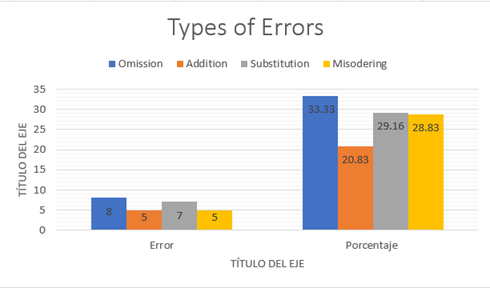
Figure 1. Distribution of morphological errors by type (frequency and percentage).
Conclusions
First, this study determined which morphological mistakes Ecuadorian students learning English as a second language most frequently made when writing brief paragraphs. The findings indicate that the most frequent mistakes are substitutions and omissions, particularly when using plural markers, verb conjugations, and fundamental grammatical morphemes. These flaws show a lack of understanding of English morphological norms, which has a detrimental effect on written texts' coherence, precision, and clarity. Morphology continues to be a major obstacle in the process of learning English as a foreign language at the university level in Ecuador, as evidenced by the observation that these kinds of mistakes remain even in guided writing exercises.
Second, the study's findings show that a number of factors, such as interference from the student's native tongue, a lack of systematic instruction aimed at fostering morphological awareness, and a lack of knowledge or application of English grammatical rules, are closely linked to the detected morphological errors. Additionally, students' written work often retains faulty structures due to the widespread use of literal translation techniques and their limited exposure to actual literature. In this regard, by making it possible to recognize common error patterns and comprehend their root causes, the research offers instructors and educational establishments useful information.
It can be said that students’ academic performance is likely to improve with the enhancement of accuracy, coherence, and efficacy of students' foreign language writing through the use of explicit and contextualized teaching strategies that reinforce morphological learning.
References
Ahmad, M., Faryal, S., & Rauf, S. (2023). Análisis de errores morfológicos en textos escritos en inglés por estudiantes de inglés como segunda lengua. Global Language Review, VIII(IV), 33-43. https://doi.org/10.31703/glr.2023(VIII-IV).04
Aziz, I. F., Aniuranti, A., & Wulandari, Y. (2023). A morphological errors analysis in descriptive texts written by the students. Economics, Social, and Humanities Journal (Esochum), 2(2), 82-96. https://journal.unupurwokerto.ac.id/index.php/esochum/article/view/120
Haris, H. (2023). Morphological errors in descriptive students’ writing. Journal of English Language and Education, 8(2), 1-7. https://www.jele.or.id/index.php/jele/article/view/394
Haspelmath, M. (2002). Grammatikalisierung: Von der Perfomanz zur Kompetenz ohne angeborene Grammatik. Gibt es eine Sprache hinter dem Sprechen?, 262-286. https://surl.li/lbokrw
Krashen, S. (1982). Principles and practice in second language acquisition. https://surl.lu/rkuubf
Larionova, E,. & Martynova, V,. (2022). Efectos de la frecuencia en el reconocimiento de errores ortográficos: un estudio ERP. Front. Psychol., 14 April 2022 https://doi.org/10.3389/fpsyg.2022.834852
López, N., & Sandoval, I. (2016). Methods and techniques of quantitative and qualitative research. http://biblioteca.udgvirtual.udg.mx/jspui/handle/123456789/176
Ma’mun, N. (2016). Los errores gramaticales en los párrafos escritos. Jurnal Vision, Volume 5 Number 1, April 2016. https://journal.walisongo.ac.id/index.php/vision/article/view/862/765
Mukherjee, J., & Hundt, M. (2011). Exploración de las variedades del inglés como segunda lengua y del inglés de los estudiantes: salvando la brecha entre paradigmas. Jhons Benjamins Publishing Company.p221(5). https://surl.lu/nsgwbv
Nordquist, R. (2020). English as a Foreign Language (EFL). https://www.thoughtco.com/english-as-a-foreign-language-efl-1690597
Poejilestari, N. (2020). An analysis of morphological and syntactical errors in recount text. JELL (Journal of English Language and Literature) STIBA-IEC Jakarta, 5(01), 9-18. https://journal.stibaiec-jakarta.ac.id/ojs-asli/index.php/jell/article/view/91
Seddik, M. (2023). Error analysis in EFL students’ writing skill. Journal of English Language Teaching and Applied Linguistics, 5(4), 163-172. https://surl.lt/ggfidz
Varela, S. (2009). Where and what is Morphology?. Studies in Hispanic & Lusophone Linguistics, 2(2). https://surl.li/tqwnsj