Fecha de recibido: 23/11/2025
Fecha de aceptado: 23/01/2026
Fecha de publicado: 09/02/2026
Introduction
In recent years, the rapid development of mobile applications has increased opportunities for personalised learning, including multisensory learning models. These tools have been proposed to improve educational outcomes, particularly in the acquisition of native language (L1) or a second language (L2) for children with specific educational needs (Agustia and Arifin, 2018). One of these groups includes students with dyslexia. Dyslexia is a term for a common learning disorder that significantly affects a child's ability to read, write, and spell. Due to these challenges, teachers working with this specific group of students often struggle to address their students' specialised educational requirements (Abdullah et al., 2023).
Mobile learning (ML) has gained recognition for its potential benefits, capacity, and flexibility, especially when combined with teacher support and feedback. Recent studies have shown that integrating mobile technologies into education introduces a range of advantages, including enhanced communication channels, opportunities for collaborative interaction, support for independent and individualised learning experiences. Furthermore, ML can help dyslexic students overcome the challenges of traditional teaching methods, and teachers can develop digital didactic content according to the needs of the students. (Abdullah et al., 2023; Heil et al., 2016; Persson & Nouri, 2018).
Writing difficulties experienced by students with dyslexia often include problems with spelling, sentence construction, and the coherent organisation of ideas. These challenges affect both languages (L1 and L2) and can affect academic performance and self-esteem. Focusing on the need for instructional strategies that support, develop, and promote writing skills, to overcome these problems and encourage an inclusive and successful education for these students.
In this context, Birsh (2018) and Snowling (2019) highlight an important concept that involves multiple senses: visual, auditory, kinaesthetic, and tactile, called "multisensory learning", where multisensory techniques in students with dyslexia are shown to be beneficial in compensating for difficulties in phonological processing by reinforcing learning through alternative sensory pathways. Several studies describe the use of multisensory mobile devices in the development of writing skills in children with dyslexia. These studies vary in methodological approaches, sample size, age ranges, types of applications, and reported results. Despite these characteristics, these studies highlight that the use of mobile devices improves the writing and spelling of the participants (Khasawneh, 2024).
Given these considerations, this research adopts a descriptive-comparative methodology that seeks to examine current multisensory mobile applications designed to improve English writing skills in children with dyslexia. The purpose of this work is to identify, analyse, and compare the data collected in research conducted in different institutions on the implementation of the multisensory mobile applications during teaching and learning English, demonstrating the reliability of the use of apps and their results.
Literature Review
Dyslexia is a medical term that describes a specific learning disability resulting from a delay in brain development, which manifests primarily as difficulties acquiring reading and writing skills. Associated linguistic deficiencies include phonological confusion in word pronunciation, reading difficulties, letter recognition errors, deficits in symbolic processing, inadequate reading comprehension, and lapses in learning attention and concentration (Álvarez & López, 2021).
Children with dyslexia have difficulty identifying and differentiating the letters of the alphabet due to their inability to understand words accurately, which can negatively impact their learning ability in any subject. In terms of Ecuador and the region, it is estimated that between 2% and 8% of school-aged children have learning difficulties related to this problem, which means that at least one to three children in each classroom have difficulties in reading and writing (Ministry of Education, 2019; Syerlyana, et al. 2025), impacting on the student's academic development, self-esteem and social integration. For this reason, mobile applications are popular tools for improving children's cognitive skills, thereby contributing to better teaching. Phonological awareness is an important consideration because sounds in spoken language are structured to identify and recognise words (Anthony & Francis, 2005). A study performed by Aldousari, (2021) investigated the effectiveness of the use of mobile applications in teaching dyslexic students in phonological awareness. The conclusion of the study indicated that the use of mobile applications can improve phonological awareness in dyslexic students.
On the other hand, the multisensory approach, widely used in dyslexia intervention, has been used mainly to teach reading and writing using different senses. Mohler (2002) argues that multisensory instruction gets its name due to information is presented through sight, sound, voice, and kinaesthetic means. Multisensory instructional practices are techniques for students to learn and practice language skills. The use of visual, auditory, kinaesthetic, and tactile methods for instruction can help students who learn through different modalities (Carreker, 2006; Schwed & Melichar-Utter, 2008). Schramma (2016) adds that multisensory learning refers to the processing of new information through more than one sensory channel, thus stimulating multiple areas in the brain. Promoting the stimulation of intellectual development and improving the development of their skills and expertise by contributing to the teaching and motivation of the creation of activities that help and encourage learning in children with dyslexia. On the other hand, inculcating correct ways to encourage the learning of English as a second language contributes to this.
Multisensory environments (MSEs) have gained popularity in educational settings serving children with severe disabilities in the United Kingdom, the United States, and Australia where these programs use a variety of visual, tactile, auditory, tactile, auditory, and kinaesthetic methods to best suit the needs of the learner in acquiring the needed skill or information. The concept of its inception is rooted in the theory of sensory integration as a means of elucidating learning and behavioural difficulties (Khasawneh, 2024). This theory was formulated by occupational therapist Jean Ayres (1965), which is based on five neurodevelopmental hypotheses. One of these hypotheses, known as the motivation hypothesis, postulates that successful acquisition of a skill fosters increased motivation to further improve one's learning abilities (Lorusso & Bosch, 2018). The multisensory approach, a tool to assist in the acquisition and retention of information, has the potential to help struggling writers improve their writing skills and metacognitive ability to acquire and retain information, has the potential to help writers with difficulties to improve their writing skills and metacognitive ability (Moats & Farrell, 2005).
This concept is also considered that the multisensory application will be a great help to develop writing skills and to succeed in the development of knowledge of children with dyslexia, who will have an advance in knowledge and skills. Other concepts are taken into account to better describe the use of these Apps. Feedback aims to enhance learning by directing subsequent actions and rectifying misunderstandings. Personalization involves customizing learning experiences, content, or interfaces to cater to the specific needs, preferences, and capabilities of individual learners. This strategy seeks to augment engagement and efficacy by adapting materials to the unique attributes of each user. Gamification entails the integration of game-design elements into non-game activities, such as learning or work, with the intent of making these activities more stimulating, engaging, and pleasurable for participants (Deterding et. al., 2011;Kulik & Fletcher, 2016).
Recent researchers have evaluated the effectiveness of mobile applications designed specifically for learners with dyslexia. In a study conducted by Madeira, et al. (2015), evaluated the efficacy of a videogame focused on a multisensory approach, aimed at students with dyslexia, integrating visual, auditory, and tactile elements in a gamified environment was evaluated. The research was conducted with a sample of eight Portuguese students aged 10-12 years, divided into two groups: one consisting of four children with a diagnosis of dyslexia and the other of four students without a diagnosis. The results showed that children with dyslexia achieved similar and even higher performances in several tasks related to word recognition, rhyming, letter sequences, and syllable structures, with an average accuracy rate of 94% and 82% respectively. These findings suggest that mobile applications designed with a multisensory approach improve learning and increase motivation and self-esteem in students with dyslexia. These applications adapt to the student's pace, level, or profile. They design specific activities for a student, featuring an intuitive visual interface, the use of dyslexic fonts, and clear, distraction-free navigation to provide correct answers or suggestions that allow the teacher to follow up.
Another study was carried out by Alenizi (2019), which analysed a study to evaluate the effectiveness of a multisensory programme in improving visual perception among primary school pupils with learning difficulties using a quasi-experimental design (cause-and-effect relationship). The research examined the impact of the intervention on an experimental group. A group of 30 third and fourth-grade students participated in a programme based on a multisensory approach, which aimed to facilitate students' use of their sensorimotor memories to comprehend intellectually stimulating texts. A control group of 30 students was also taught traditional methods of reading comprehension. The study compared students' visual perception skills before and after the intervention to determine the effectiveness of the instructional approach. The results indicated a difference in visual perception skills between the two groups, with the multisensory approach being favoured. This study suggests that connecting sensory experiences with reading materials is advantageous for students.
Given these considerations, significant challenges are faced by children with dyslexia in developing writing skills, particularly in English as a second language. Multisensory approaches, when integrated into mobile applications, have shown promise in addressing these difficulties by offering more engaging and individualised learning experiences. Although various studies (Kast et al., 2007; Khasawneh, 2024; Abdullah et al., 2021; Tacle et al., 2025) have demonstrated improvements in writing performance, a comparative analysis is needed to better understand their results and identify the most effective strategies. Therefore, the following research questions guide this study: What multisensory strategies are integrated into mobile applications aimed at improving writing in children with dyslexia? And how do the results of these studies compare in terms of writing performance and learner engagement?
Materials and Methods
This research follows a qualitative descriptive-comparative approach to identify how multisensory mobile applications support English writing development in children with dyslexia, analysing the pedagogical features and educational impact of selected mobile apps designed for students with these problems. Following this criterion, results were compared to show how different apps address the development of writing skills through multisensory strategies. For this reason, studies were chosen from research sources, namely, peer-reviewed articles and academic reports that evaluated mobile apps to help dyslexic students.
Data Collection
A comparative analysis was conducted focusing on six pedagogical features: Multi-sensory approach, Gamification, Personalization, Feedback, and Adaptability (Lerga et al., 2021). In this way, each application was examined to identify which of these characteristics were present in these approaches. From this information, a qualitative and descriptive summary was produced showing the frequency and distribution of these pedagogical features in the selected applications. In order to compare the different results of each application in “Table 1”, explain the main skills improved.
Seven mobile apps were selected based on specific inclusion criteria: Designed or adapted for students with dyslexia, incorporating multisensory or gamified learning components, referenced in peer-reviewed academic literature between 2014 and 2019, and presenting reported results on writing or related literacy skills. Thus, the selected apps were iLearnRW, EasyLexia, DysEggxia, LexiPal, ClassDojo, OmoReader, and ICT-AAC apps. The data were extracted from academic research and organised in a comparative matrix. The analysis took into account the country of origin, target competences, instructional design features, and reported outcomes. In this way, findings were analysed to determine how multisensory apps contribute to writing skill development, where finally, results were integrated into a descriptive and narrative study supported by figures and tables.
Table 1. Main features of the apps selected.
|
Study |
Country |
App Name |
Skills Improved |
|
Zakopoulou, et al., 2017 |
Croatia |
iLearnRW |
Reading/ Writing |
|
Skiada, et al., 2014 |
Greece |
EasyLexia |
Reading/Spelling/ Comprehension |
|
Rello, et al., 2014 |
Spain |
DysEggxia |
Spelling |
|
Saputra, 2015 |
Indonesia |
LexiPal |
Reading/ Writing |
|
Gooch, et al., 2016 |
California |
ClassDojo |
Writing |
|
Šarac, 2019 |
Croatia |
OmoReader |
Reading |
|
Zorić, 2019 |
Croatia |
ICT-AAC applications |
Reading/Writing |
Results and Discussion
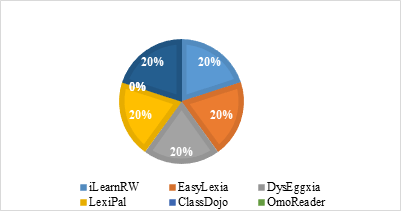
The comparative analysis of the selected mobile applications revealed significant patterns in both the pedagogical strategies employed and the skills aimed to improve in children with dyslexia. The findings were organized into two key dimensions based on Lerga et al. (2021) study: Figure (1) Pedagogical functions referring to the instructional design features integrated into the application (Multisensory approach, Gamification, Personalisation, Feedback, Adaptability) and Figure (2) Targeted literacy skills, referring to the specific abilities the apps seek to develop in children with dyslexia. (Reading, Writing, Spelling, Reading
 |
comprehension), each application was coded for the presence or absence of these features.
Figure 1. Pedagogical functions of multisensory Mobile Applications
Based on the analysis of the Pedagogical functions of multisensory Mobile Applications, Figure 1 above, the Multisensory approach was the most frequently implemented strategy, present in five of the seven applications. This indicates that the integration of visual, auditory, tactile, and kinaesthetic elements can improve the learning outcomes of dyslexic students. Similarly, the gamification approach was used in five of the seven apps, underscoring its importance in increasing motivation, engagement, and sustained attention. Personalisation features, however, are presented in three of the seven apps, suggesting that fewer tools offer customised learning paths adapted to individual needs, where, for Heil et al. (2016), personalization characteristics are important for the improvement and development of cognitive skills (Heil et al., 2016).
Feedback mechanisms within the user interface were only present in two applications, indicating that most of the tools do not provide real-time guidance, which is important to support self-regulation in dyslexic students. Finally, adaptability emerged as the least frequently implemented feature, observed in only one application, indicative of a prevailing limitation in tailoring the learning experience to accommodate diverse learning styles. According to Ravenscroft (2008), this may limit users' ability to self-correct and reduce cognitive load, two particularly important elements in dyslexia remediation. Among the analysed applications, iLearnRW, DysEggxia, and ClassDojo stood out as the most instructionally comprehensive, as they integrated three or more pedagogical features.
Regarding the analysis and results of Literacy Skills Targeted, each application was evaluated based on the skills reported as improved. Each skill was coded as present or absent in each application. Subsequently, the frequency of occurrence was calculated and converted into percentages, as shown in Figure 2 below. The results reflect general trends in skill prioritization for students with dyslexia.
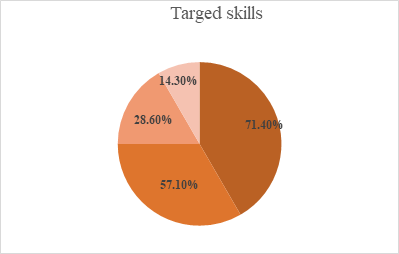 |
Figure 2. Percentage of Literacy Skills Targeted.
Reading was the most frequently supported skill, addressed by more than 70% of the applications, where the most focus on improving reading accuracy, phonological awareness, and even orthographic recognition. Writing then appeared in 57.1% of the applications; however, writing support was indirect, often provided through spelling tasks rather than structured composition or sentence-building activities. On the other hand, only 28.6% of the applications addressed spelling, with DysEggxia being the most specialized tool, which uses an error-based approach to correct common spelling mistakes in dyslexic students. Reading comprehension was the least prioritized skill, present in only one application (EasyLexia), representing 14.3% of the sample. These results indicate that, while applications offer valuable support in basic literacy skills, especially decoding and spelling, a clear gap persists in tools that address higher-order writing skills, such as coherence, organization of ideas, sentence structure, and text production.
The analysis reveals that while multisensory mobile apps present a potential avenue for supporting dyslexic learners, their approach to addressing essential language skills, especially writing, lacks uniformity. A predominant focus on basic skills such as decoding and spelling overshadows the provision of structured assistance with sentence construction, coherence, or the development of ideas in written expression. Furthermore, the lack of consistency in the integration of functions such as feedback and adaptability suggest that many applications have not yet incorporated the principles of inclusive, user-centred instructional design. The results suggest that there is a positive correlation between the incorporation of multiple features in apps and improved learner engagement and writing proficiency, although this requires further empirical testing, e.g., the combination of these aspects (e.g., multisensory + personalisation + feedback) would improve the skills of learners with these problems. Immediate feedback systems, and writing exercises that go beyond spelling correction, while also incorporating materials that foster communication, expression, and comprehension in real-world settings.
Discussion
The findings of this study provide a comprehensive understanding of how multisensory mobile applications designed for dyslexic students integrate both pedagogical features and language skill development. Overall, the results indicate that while current applications show strong potential, there are significant inconsistencies in their instructional design and the specific writing skills they target. However, an important finding is the wide use of multisensory and gamified strategies, which appear across most of the applications. Reflecting a growth trend in pedagogical technology, aligned with the concepts of multisensory learning by Birsh (2018) and Carreker (2006), who argue that dyslexic learners benefit from instructional activities that engage sensory pathways simultaneously, as is shown in the findings of this investigation. Focusing now on the prevalence of gamification terms, the findings revealed that reward and interactive challenges help learners’ attention and motivation, useful for students who have experienced frustration with traditional learning. Snowling (2019) underlines that these attributes are recognized for bolstering attention, engagement, and memory through the activation of diverse sensory modalities, offering particular advantages to dyslexic learners who commonly face challenges in phonological processing.
Despite these positive results, the limited presence of personalisation, adaptability, and feedback features in the reviewed applications raises concerns regarding their instructional adaptability. According to Abdullah et al. (2021), personalisation plays an important role in meeting the unique cognitive and emotional needs of dyslexic learners. Its absence can reduce the application's ability to adapt instruction to individual learning profiles. Similarly, Ravenscroft (2008) argues that feedback is essential to foster self-regulation and error correction, two crucial elements for students with language difficulties. The results of this study corroborate the identified shortcoming; although certain applications feature robust multisensory design elements, they commonly omit functionalities that foster user reflection or adaptive learning processes.
Collectively, an analysis of the language skills addressed by these applications reveals a prioritization of reading and spelling, often within the framework of reading comprehension and writing. This pattern reflects the traditional focus on decoding and spelling as fundamental components of dyslexia rehabilitation, as observed by as noted by Kast et al. (2007). However, it highlights a limitation of educational software. When writing is incorporated, it is generally addressed indirectly, primarily through spelling exercises, rather than through the systematic facilitation of sentence formation or the organization of ideas. DysEggxia is a clear example, as this app stands out for its error-based approach to spelling correction, providing specific feedback based on common dyslexia patterns. This contrasts with other apps that present writing activities more generally, without specific error correction. Furthermore, reading comprehension remains absent in most apps, appearing explicitly in only one case (EasyLexia). This suggests a lack of attention to higher-order language skills, crucial for academic success, especially in the context of English as a Foreign Language (EFL).
These results suggest a clear imbalance in the design priorities of current apps. While most tools are effective in reinforcing basic skills, such as decoding, sound-letter correspondence, and word recognition, the apps are often insufficient for developing expressive and cognitive-linguistic skills, requiring intervention from professionals specializing in dyslexia in more severe cases. According to the criteria of Khasawneh (2024) and Falk-Ross (2001), this is particularly problematic given that students with dyslexia require long-term support not only in reading accuracy but also in written fluency, coherence, and comprehension.
These trends suggest that most mobile apps for dyslexic students focus primarily on decoding and text processing, while language skills such as writing and reading comprehension do not receive sufficient attention. This finding aligns with the emphasis on phonological and orthographic skills in dyslexia research (Kast et al., 2007; Snowling, 2019), but contrasts with more recent studies, such as Khasawneh's (2024), which highlight the importance of fostering writing fluency and confidence through multisensory instruction. The limited attention given to reading and writing also reveals a potential gap in the pedagogical design of current apps, as some tend to employ traditional teaching methods. These findings encourage the development of tools that balance decoding and communicative skills, especially in the context of learning English as a foreign language (EFL). This study demonstrates that an integrated assessment of instructional features and progress in language skills indicates that, while mobile applications offer substantial support to students with dyslexia, they still fall short in terms of pedagogical rigor and cohesive functionality. Future iterations should emphasize the inclusion of adaptive learning pathways.
Conclusions
This study analysed the pedagogical characteristics and literacy outcomes of multisensory mobile applications designed to support children with dyslexia in developing their writing skills and learning English. The findings indicate that, while these applications represent a promising and innovative educational resource, their didactic components vary considerably, and significant shortcomings persist in their ability to comprehensively support writing development. Most of the apps demonstrated intensive use of multisensory strategies and gamification, widely recognized by experts and teachers for improving motivation, attention, and memory in dyslexic students. These features encourage engagement and help create learning environments that reduce frustration and anxiety, common barriers for children with reading and writing difficulties. However, the study also revealed a limited presence of personalization, adaptability, and feedback mechanisms, all of which are essential for addressing the diverse needs of dyslexic students and promoting effective self-regulation.
While the reviewed applications offer beneficial strategies for strengthening basic literacy skills, the findings underscore the need for tools that provide structured writing assistance, adaptive learning pathways, and continuous feedback. These improvements would be better suited to inclusive pedagogical frameworks and would increase their effectiveness in authentic classroom settings. In particular, the integration of multimodal resources that go beyond visual and auditory modalities, such as haptic feedback or gesture interfaces, could further enhance the engagement and learning outcomes of students with dyslexia (Javed et al, 2024).
Recommendations
The use of multisensory mobile applications for dyslexic students must extend beyond basic reading and spelling activities. It must incorporate strategies that promote the overall development of writing skills, such as organizing ideas, constructing sentences, and ensuring textual coherence. To achieve this, technological tools must integrate mechanisms for personalization, feedback, and adaptability to meet the individual needs of students, foster self-regulation, and provide relevant learning experiences. Teachers and designers must recognize that educational technology should complement, not replace, traditional teaching. It is essential to prioritize inclusive, interactive, and motivating approaches that contribute to the progressive development of dyslexic students' linguistic and cognitive abilities.
References
Abdullah, N., Mohamad, M., Mageswaran, A., & Sanmugam, L. (2023). Empowering Dyslexic Children’s Literacy through Mobile Applications and Multisensory: Addressing the Challenges Faced by Special Needs Teachers. https://cplt.uitm.edu.my/v1/images/v11n3/Article7.pdf
Agustia, R., & Arifin, I. (2018). Implementation of a visual, auditory, kineshthetic, tactile model learning system to help mild retarded children in alphabetical and numeric learning. IOP Conference Series: Materials Science and Engineering. IOP Publishing. https://iopscience.iop.org/article/10.1088/1757-899X/407/1/012009/meta
Aldousari, A. (2021). Mobile applications for students with dyslexia: A systematic literature review. American Research Journal of Humanities and Social Sciences, 7(1).1-7. https://www.researchgate.net/publication/349465421_Mobile_Applications_for_Students_with_Dyslexia_A_Systematic_Literature_Review
Álvarez, Á., & López, C. (2021). Percepción de la dislexia en el aula por los docentes: una revisión. Tempus Psicológico, 4(1), 29-43. https://doi.org/10.30554/tempuspsi.4.1.3373.2021
Anthony, J., & Francis, J. (2005). Development of phonological awareness. Current directions in psychological Science, 14(5), 255-259. https://journals.sagepub.com/doi/abs/10.1111/j.0963-7214.2005.00376.x
Ayres, A. (1965). Patterns of perceptual-motor dysfunction in children: A factor analytic study. Perceptual and Motor Skills, 20(2), 335-368. https://journals.sagepub.com/doi/abs/10.2466/pms.1965.20.2.335
Birsh, J. (2018). Multisensory Teaching of Basic Language Skills. (4th Edition) Independent Literacy Consultant. https://goo.su/FUR7w
Carreker, S. (2006). Teaching reading: Accurate decoding. En M. Joshi & P. Aaron (Eds.), Handbook of orthography and literacy (pp. 411–426). Lawrence Erlbaum Associates.https://www.researchgate.net/publication/353157189_The_Role_of_the_Multisensory_Approach_in_Developing_English_Writing_Skills_and_Metacognitive_Awareness_of_Struggling_Writers_at_the_Preparatory_Stage
Heil, C., Wu, J., Lee, J., & Schmidt, T. (2016). A review of mobile language learning applications: Trends, challenges, and opportunities. The EuroCALL Review, 24(2), 32-50. https://www.researchgate.net/publication/313114355_A_Review_of_Mobile_Language_Learning_Applications_Trends_Challenges_and_Opportunities
Javed, S., Muniandy, M., Lee, C. K., & Husni, H. (2024). Enhancing teaching and learning for pupils with dyslexia: A comprehensive review of technological and non-technological interventions. Education and Information Technologies, 29(8), 9607-9643. https://link.springer.com/article/10.1007/s10639-023-12195-5
Khasawneh, M. (2024). Evaluating the impact of multisensory instruction on dyslexic learners’ writing skills in English language learning. Journal of Southwest Jiaotong University. https://jsju.org/index.php/journal/article/view/2030
Lorusso, M. L., & Bosch, M. J. (2018). The use of sensory integration therapy to improve learning and behavior in children with developmental disorders. https://www.researchgate.net/publication/377594073_Kurdish_Studies_The_Role_of_the_Multi-Sensory_Environment_in_Developing_Learning_Skills_Among_Students_with_Learning_Difficulties_in_the_Asir_Region
Ministerio de Educación del Ecuador. (2019). Curriculum for Basic General Education [Currículo de Educación General Básica]. https://www.educacion.gob.ec/
Moats, L. C., & Farrell, M. L. (2005). Multisensory instruction. International Dyslexia Association. https://n9.cl/f99sps
Mohler, L. (2002). Multisensory strategies for developing phonological and orthographic awareness. En B. R. Foorman (Ed.), Preventing and remediating reading difficulties: Bringing science to scale (pp. 63–86). York Press. https://www.researchgate.net/publication/353157189_The_Role_of_the_Multisensory_Approach_in_Developing_English_Writing_Skills_and_Metacognitive_Awareness_of_Struggling_Writers_at_the_Preparatory_Stage
Persson, V., & Nouri, J. (2018). A systematic review of second language learning with mobile technologies. International Journal of Emerging Technologies in Learning, 13(2). https://acortar.link/zlqcH6
Ravenscroft, G. (2008). Remedial instructional techniques: Assessing the effectiveness of high imagery teaching techniques in the remedial environment (Doctoral dissertation, University of the Witwatersrand). https://core.ac.uk/download/pdf/39665692.pdf
Schramma, E. (2016). Multisensory learning and technology in the acquisition of English as a second language. EnglishHelper™ Inc. https://www.researchgate.net/publication/353157189_The_Role_of_the_Multisensory_Approach_in_Developing_English_Writing_Skills_and_Metacognitive_Awareness_of_Struggling_Writers_at_the_Preparatory_Stage
Schwed, M., & Melichar-Utter, J. (2008). Meeting the needs of struggling readers through multisensory teaching. Ohio Reading Teacher, 42(1), 17–22. https://www.researchgate.net/publication/353157189_The_Role_of_the_Multisensory_Approach_in_Developing_English_Writing_Skills_and_Metacognitive_Awareness_of_Struggling_Writers_at_the_Preparatory_Stage
Snowling, M. (2019). Dyslexia: A very short introduction. Oxford University Press. https://www.researchgate.net/publication/333323103_Dyslexia_A_Very_Short_Introduction
Syerlyana, A., Islami, M., Yanti, R., Kusmana, S., & Rahayu, I. (2025). Application of Multisensory Strategies in Differentiated Classroom Learning to Overcome Reading Delay in Elementary School Students. JTP-Jurnal Teknologi Pendidikan, 27(2), 487-499.
Khasawneh, M. (2024). The Role of the Multi-Sensory Environment in Developing Learning Skills Among Students with Learning Difficulties in the Asir Region. Kurdish Studies, 12(1). https://kurdishstudies.net/menu-script/index.php/KS/article/view/1433/1051
Kulik, J. A., & Fletcher, J. D. (2016). Effectiveness of intelligent tutoring systems: a meta-analytic review. Review of educational research, 86(1), 42-78. https://journals.sagepub.com/doi/abs/10.3102/0034654315581420
Deterding, S., Dixon, D., Khaled, R., & Nacke, L. (2011, September). From game design elements to gamefulness: defining" gamification". In Proceedings of the 15th international academic MindTrek conference: Envisioning future media environments (pp. 9-15). https://dl.acm.org/doi/abs/10.1145/2181037.2181040
Madeira, J., Silva, C., Marcelino, L., & Ferreira, P. (2015). Assistive mobile applications for dyslexia. Procedia computer science, 64, 417-424. https://www.sciencedirect.com/science/article/pii/S1877050915026708
Alenizi, M. (2019). Understanding of Reading among Teachers and Learners: A Descriptive Study of Pre-University English Language Teaching/Learning in Saudi Arabia. Arab World English Journal, 10(2), 293-306. https://eric.ed.gov/?id=EJ1275327
Kast, M., Meyer, M., Vögeli, C., Gross, M., & Jäncke, L. (2007). Computer-based multisensory learning in children with developmental dyslexia. Restorative Neurology and Neuroscience, 25(3-4), 355-369. https://journals.sagepub.com/doi/abs/10.3233/RNN-2007-253417
Lerga, R., Candrlic, S., & Jakupovic, A. (2021). A Review on Assistive Technologies for Students with Dyslexia. CSEDU (2), 64-72. https://www.scitepress.org/Papers/2021/104345/104345.pdf
Falk-Ross, F. C. (2001). Toward the new literacy: Changes in college students' reading comprehension strategies following reading/writing projects. Journal of Adolescent & Adult Literacy, 45(4), 278-288. https://www.jstor.org/stable/40012204
Tacle, L., Guevara, K., Andrade, L., & Castillo, C. (2025). Estrategias didácticas innovadoras para el apoyo a estudiantes con dislexia en lengua y literatura: Innovative didactic strategies for supporting dyslexic students in language and literature. LATAM Revista Latinoamericana de Ciencias Sociales y Humanidades, 6(1), 100-112. https://latam.redilat.org/index.php/lt/article/view/3322#:~:text=Los%20resultados%20revelaron%20que%20el,integral%20en%20el%20sistema%20educativo.