Fecha de recibido: 19/11/2025
Fecha de aceptado: 23/01/2026
Fecha de publicado: 09/02/2026
Introduction
The presence of artificial intelligence in education has begun to transform the way academic texts and linguistic tasks are produced; various applications, ranging from automatic correction systems to content generators, are reshaping the experience of learning languages. Authors such as Godwin-Jones (2022) note that current tools “open an unexpected door for language learners to explore new ways of creating and revising texts,” an idea that helps explain why academic debate has shifted toward examining their effects on writing processes. Even so, the adoption of these technologies does not unfold in a single direction; rather, it evolves according to institutional realities.
In different educational settings, students and instructors coexist with automated systems that offer vocabulary suggestions, sentence reformulation, and discourse organization; this coexistence generates new dynamics in English language teaching. According to Mushthoza et al. (2023), AI applications often intervene in aspects related to syntactic structure and textual cohesion; such intervention has sparked discussions about their actual contribution to learning. Consequently, questions arise regarding how traditional methods coexist with these digital assistants.
Although digital systems promise immediate improvements, not all institutions perceive their benefits in the same way; some integrate them confidently, while others advance more cautiously. Alharbi (2023) explains that many students “feel accompanied by an assistant that does not evaluate them but offers expressive possibilities,” a perception that may influence motivation. However, this proximity also raises questions about how much it alters the genuine process of developing academic thinking.
Within this landscape, writing in English takes on particular relevance; it is a skill that has historically required practice, feedback, and detailed revision. For this reason, several authors argue that the introduction of AI generates opportunities but also gray areas. Yeh and Lin (2024) point out that technology-mediated feedback reorganizes revision patterns, although it does not always deepen students’ understanding of why a sentence should be adjusted. These views suggest that the phenomenon warrants further examination.
As technology advances, expectations for written production also change; both teachers and students look for tools that facilitate the organization of ideas without compromising coherence. Some processes become automated, while others are redesigned. Woo and Chen (2024) found that in certain classrooms, students use AI—particularly ChatGPT and automated grammar-checkers—to generate initial ideas and later refine them with teacher guidance. Nonetheless, this practice is not uniform and varies depending on language proficiency.
Over time, it becomes evident that AI-assisted writing influences how paragraphs are structured, arguments expressed, and linguistic doubts resolved; this influence is not always perceived positively. Nan (2025) notes that the impact goes beyond correcting superficial errors and may introduce repetitive patterns that reduce syntactic complexity when used uncritically. Thus, it becomes necessary to examine these tensions more carefully.
Although interest in understanding the phenomenon has grown, there is still debate about whether these tools truly enhance learning or merely make it appear more efficient; studies diverge in their results. Cancino and Panes (2021) observed that automated support increases accuracy in certain types of errors yet does not resolve discourse-level difficulties; this finding suggests that AI may contribute unevenly. Consequently, the debate remains open.
Across Latin American institutions, the topic is approached with growing curiosity; many classrooms already use systems such as ChatGPT and Grammarly for the revision of short texts or guided writing activities. Reports by Naranjo-Pozo et al. (2025) indicate that student production changes when AI is incorporated from the first draft; such change merits analysis based on learners’ real experiences. For that reason, the present study approaches the phenomenon from a situated perspective.
Gradually, it becomes clear that it is not enough to know whether AI corrects or not; what matters is how it intervenes in the relationship between teacher and student. Authors like Ayoub et al. (2025) point out that automatically generated feedback “may be accurate in form but does not always dialogue with communicative intent,” which leaves open questions. These questions resonate strongly in classrooms where writing is understood as a social practice.
Throughout these discussions, a shared point emerges: writing requires decision-making during planning, drafting, and revision. Current technologies accompany these steps, although they do not always explain the rationale behind each suggestion; this ambiguity motivates inquiry into how learners experience the process. Thus, an opportunity arises to explore students’ perceptions of their learning.
As the phenomenon is examined more deeply, the need to establish the research concern becomes evident; reflection turns toward the relationship between artificial intelligence and the development of English writing skills. This leads to a guiding question that articulates the purpose of the study: In what ways does the use of artificial intelligence tools intervene in the academic writing processes of university students learning English as a foreign language? This overarching question opens space for more specific concerns, leading the study to be guided by three research questions:
1) How do students perceive the benefits of using artificial intelligence tools to improve their performance in English writing?
2) How do students evaluate the accuracy and usefulness of AI-generated feedback during their writing process?
3) In what ways do these tools help students overcome writer’s block or difficulties generating ideas?
From this set of questions emerges an initial purpose: to describe how students use these tools to plan and produce texts, to understand what kinds of improvements they perceive during revision, and to identify the tensions that arise between AI suggestions and teacher expectations. Based on this, the general objective of the study is defined: to analyze students’ perceptions of the use of artificial intelligence as support for the development of written expression in English. Complementary to this, three specific objectives guide the research:
a) To examine the extent to which these tools contribute to improving grammar, vocabulary, and coherence in students’ written texts.
b) To compare writing samples produced with and without AI assistance in order to identify variations in textual quality and structure.
c) To determine the pedagogical opportunities, limitations, and possibilities derived from the incorporation of artificial intelligence into university-level English teaching, particularly in academic writing tasks.
Achieving these objectives requires more than merely describing tools; it demands examining real practices. Classrooms become spaces where established habits interact with newly introduced tools; from this interaction emerge experiences that deserve careful attention. Detailed exploration may reveal nuances that do not always surface in more quantitative studies.
The justification of this study rests on several factors; educational institutions seek to understand how these technologies modify study habits and writing practices. Previous research has shown varied effects. For example, Woo et al. (2023) note that students often feel more confident when receiving immediate guidance, although they do not always internalize suggested changes. This invites a more situated examination of the phenomenon.
Furthermore, writing in English remains a valued skill in both academic and professional settings; understanding how it transforms under technological mediation may provide insights for designing more appropriate instructional strategies. Observations from Yeh and Lin (2024) reinforce this perspective by arguing that revision patterns change considerably when feedback is automated.
Likewise, the study is justified because it addresses a contemporary issue present across university courses; instructors and students are increasingly interested in knowing whether these tools foster autonomy or dependence. According to Dong (2023), automated support may improve vocabulary and structure, although it does not replace reflective processes that require human guidance; this opens a pedagogical space for reflection.
Therefore, the value of this research lies in understanding a contemporary educational experience; it is not solely about evaluating a tool but about observing how it intertwines with habitual writing practices. Pedagogical decisions are not improvised; they are built upon real experiences and careful analysis. This article offers an approach to that evolving reality.
With these ideas as a starting point, the study moves toward a systematic exploration of perceptions, experiences, and evidence; each section contributes to understanding how AI integrates into language learning and what possibilities it opens for academic work at the university level.
Recent studies on AI-assisted writing have begun to shape a coherent overview of how English writing processes are being transformed; each contribution adds a particular nuance to the understanding of how textual production evolves when artificial intelligence becomes part of academic work. In this line, the study by Sohrabi et al. (2023) offers one of the most frequently cited analyses in recent literature, as it explores the effects of automated feedback on accuracy and written complexity among EFL learners. The design is quasi-experimental, with one group receiving traditional teacher feedback and another working with automatic tools. The findings reveal improvements in grammatical accuracy and moderate gains in syntactic complexity; in addition, revisions are completed in less time when AI is involved. The authors conclude that automation contributes effectively to early correction stages, although it does not replace reflective processes. This contribution is relevant to the present research because it opens the discussion on the type of revision students incorporate during the drafting phase.
Building on this foundation, the study by Yeh and Lin (2024) introduces another valuable perspective; these authors analyze how AI-mediated feedback reorganizes the revision experience of university students. Their methodology combines comparative analysis of drafts with semi-structured interviews; this design allows the researchers to observe not only textual changes but also the interpretations students make of those adjustments. The results show that AI accelerates the editing process but does not always strengthen students’ understanding of the rationale behind each modification; many participants accept suggestions without examining them critically. The conclusion states that automation can enhance workflow fluency, although it does not necessarily promote autonomy. This point directly connects to the current study, as it highlights the need to examine how students interpret each technological intervention.
As these studies progress, the work of Naranjo-Pozo et al. (2025) broadens the discussion by focusing on the secondary-school level; here, the emphasis is on the full writing process, from idea generation to the final version. The approach is mixed-methods, combining linguistic quality assessments with an analysis of student perceptions. Their findings show that AI supports initial content organization and paragraph development; however, it also produces repetitive structures when used without teacher guidance. The conclusion suggests that interaction with the tool requires pedagogical mediation to prevent dependence. This insight contributes to the present research by showing how AI reshapes textual architecture depending on the learner’s educational stage.
Complementarily, the study by Woo and Chen (2024) investigates student perceptions of ChatGPT-generated feedback in academic writing tasks. The research employs a qualitative design based on draft analysis and focus group interviews; this design reveals tensions between students’ personal voice and the automated suggestions they receive. The findings indicate that learners value the clarity and speed of AI feedback, although several participants mention that certain recommendations homogenize individual writing styles; they also describe that revision becomes mechanical when suggestions are accepted without question. The conclusion emphasizes that teacher intervention remains necessary to preserve communicative intent. This aligns with the present study, as it encourages examination of decision-making during AI-assisted revision.
In another line of inquiry, Al-Raimi et al. (2024) analyze students’ everyday interaction with AI tools at a university center in Oman; the study is based on a survey administered to 61 EFL participants. The findings show positive perceptions regarding the use of AI to generate ideas, correct frequent errors, and translate expressions during writing; in addition, students tend to use the tool more for resolving immediate difficulties than for structuring complex arguments. The authors conclude that AI becomes part of students’ routines as a quick, though not necessarily deep, resource. This evidence relates to the present research because it helps explain the real habits that shape learners’ engagement with AI-assisted writing.
The conceptual review by Nan (2025) examines the influence of AI on the linguistic complexity of English texts. The author reviews studies across different educational levels and concludes that AI enhances lexical precision and reorganizes syntactic structures through advanced patterning; however, it may also foster dependence if used without academic guidance. The conclusion proposes hybrid instructional models as a balanced alternative. This contribution is connected to the current study because it invites reflection on how to maintain equilibrium between automation and the autonomous construction of meaning.
Artificial Intelligence: Conceptual Approaches in Higher Education
Artificial intelligence has become one of the most widely discussed resources within academic environments; its presence extends from recommendation systems to platforms capable of generating complex texts. According to Chan and Hu (2023), AI is understood as a set of algorithms capable of identifying patterns, processing information, and producing responses that imitate human processes. This perspective positions AI not as an autonomous entity but as a tool that organizes data and amplifies certain tasks.
Within universities, the impact is particularly noticeable; students interact with systems that correct errors, explain concepts, and model discursive structures. Dergaa et al. (2023) state that these technological environments influence how information is reviewed and how ideas are constructed, opening a field of inquiry for teaching and learning. Thus, AI emerges as an intermediary between the student and the cognitive processes involved in meaning-making.
Although the possibilities are broad, this technology also introduces tensions; automation can facilitate some operations while simultaneously displacing reflective processes. Baek et al. (2024) note that the speed with which models respond may create an impression of efficiency, even when students do not fully examine how an idea is formed. This mixture of benefits and contradictions serves as a starting point for analyzing current writing practices.
In this sense, AI becomes an object of study that helps illuminate new educational dynamics; its presence alters planning, revision, and interaction in university classrooms. For this reason, it becomes a key conceptual reference for analyzing how higher-education students produce English-language texts when they receive technological assistance.
ChatGPT: Features, Functioning, and Educational Uses
Among AI-based tools, ChatGPT occupies a prominent position; it is a conversational model trained to generate and understand natural language based on large amounts of data. Sarrion (2023) explains that its structure is built on the Transformer architecture, which identifies patterns and produces coherent responses based on the input it receives. This design enables it to act as an adaptable textual assistant capable of adjusting tone and style.
Its versatility has drawn increasing attention in education; Marín Guamán (2023) highlights that ChatGPT can generate academic, technical, or conversational responses depending on the request, which broadens its didactic applications. In language learning, this flexibility allows students to observe writing samples, review structures, and compare styles; thus, it becomes a resource for practicing without the immediate pressure of teacher correction.
Moreover, studies such as Lund and Wang (2025) show that the model helps explore vocabulary, advanced structures, and discursive variations; students can experiment with different ways of expressing the same idea. However, the system does not reason; it predicts linguistic sequences based on prior patterns, meaning its accuracy depends on the quality of its training data.
Therefore, ChatGPT operates as a mediator between automation and creativity; its value depends on how students use it. When used critically, it strengthens discursive competencies and fosters self-evaluation; when adopted uncritically, it can limit personal authorship. This duality makes it a key element for understanding AI-assisted academic writing.
Academic Writing in English as a Foreign Language
Academic writing in English is a demanding task for university students; it requires organizing ideas, selecting appropriate vocabulary, and maintaining discursive coherence. Mahapatra (2024) notes that language learners often struggle to structure arguments and adapt tone to different genres. This scenario explains the growing interest in technological support tools; they provide immediate guidance and clarify doubts that previously depended solely on the instructor.
Unlike traditional grammar checkers, tools like ChatGPT can explain why one structure is more appropriate than another; Bonner et al. (2023) emphasize that such interaction supports situated learning, where students understand the internal logic of corrections. Even so, usefulness depends on the learner’s attitude toward revision; accepting suggestions without analysis reduces opportunities to strengthen academic thinking.
Yanuarti et al. (2025) observe that the impact of these tools varies according to linguistic proficiency; advanced learners explore complex expressions, while beginners focus on basic correction. This contrast shows that AI does not replace formal instruction; it complements it. The learning experience depends, therefore, on how both mechanisms are integrated.
In sum, English writing provides an ideal space for studying automated assistance; the task requires balancing technical precision and discursive construction. Thus, this component of the theoretical framework links students’ linguistic competence with the use of generative systems.
Student Perceptions of ChatGPT in Writing Processes
Student perceptions offer a useful lens for understanding how university learners interact with this tool; subjective experience determines whether AI becomes a form of support or a substitute for reflection. Nelson et al. (2025) found that many students value the clarity of feedback and the reduction of anxiety during writing; however, they also express concerns about losing authenticity in their texts. This duality appears strongly in research examining transitions toward hybrid learning models.
Vo and Nguyen (2024) expand this discussion by showing that perceptions vary according to cultural background; in some contexts, automated assistance is accepted without hesitation, while in others it is evaluated with more critical distance. In both cases, perception carries a formative and ethical dimension, as it involves assessing not only usefulness but also the legitimacy of the tool.
Ali et al. (2023) note that a large portion of positive evaluations relates to a reduced fear of making mistakes; ChatGPT creates a practice environment free from the judgment of a teacher. Even so, students acknowledge that excessive dependence can weaken control over their learning process. This tension becomes especially relevant in academic writing courses.
Uppal and Hajian (2025) add that perception also depends on transparency; students appreciate knowing which parts of the text come from them and which arise from the system. Understanding student perception, therefore, helps explain the development of habits, expectations, and writing practices.
ChatGPT and the Improvement of Grammar, Vocabulary, and Textual Coherence
Interest in understanding how ChatGPT influences linguistic aspects of writing has become recurrent; multiple studies agree that the model can strengthen grammatical accuracy when students use it reflectively. Barrot (2023) shows that contextualized explanations of verb tenses and prepositions help reduce frequent errors and clarify idea formulation. This immediate feedback creates an environment where students rehearse and correct without waiting for delayed comments.
Regarding vocabulary, several studies indicate that the model expands lexical repertoire by suggesting synonyms and register variations according to communicative purpose. Athanassopoulos et al. (2023) note that constant exposure to varied suggestions helps learners recognize nuances, although they caution that the process may become superficial if expressions are adopted without understanding real usage; lexical richness requires internalization, not mechanical substitution.
Concerning textual coherence, the tool models connectors, transitions, and paragraph structures, helping students observe how discourse is organized. However, Mahapatra (2024) emphasizes that overall coherence depends on communicative intention—something the model does not always interpret accurately. For this reason, AI-generated revision should be complemented with human feedback that contributes semantic nuance and thematic cohesion.
From this perspective, ChatGPT has clear potential to enhance technical aspects of writing; nonetheless, deep learning emerges only when students question, adapt, and rewrite suggestions. The tool can open doors, but discursive development depends on critical interaction with the text.
Pedagogical Advantages and Limitations in English Language Teaching
In pedagogical settings, ChatGPT emerges as an appealing support for educators seeking to energize writing classes; Ravšelj et al. (2025) argue that the model promotes autonomous learning by providing immediate and level-appropriate information. This immediacy reduces anxiety associated with public errors, allowing learners to practice more freely. Students can review structures and receive guidance without waiting for formal feedback sessions.
However, the tool also presents limitations that must be addressed with caution. Dergaa et al. (2023) warn that excessive use may weaken cognitive self-regulation; the ease of receiving instant responses may replace essential reflective processes necessary for learning to write. Ethical concerns regarding originality and transparency also arise, as some students may present AI-generated texts as their own.
From the instructor’s perspective, integrating ChatGPT requires rethinking evaluation criteria; Baek et al. (2024) note that textual authenticity becomes harder to determine when technological assistance is available. Consequently, some universities have begun setting ethical guidelines to encourage responsible use that supports learning instead of replacing academic effort.
Hybrid Models of Revision and AI-Assisted Learning
The integration of ChatGPT into writing routines has led to hybrid models in which automated revision is combined with teacher feedback. This intermediate approach aims to leverage the strengths of both systems; the speed of algorithms and the interpretive sensitivity of human instructors. Bonner et al. (2023) highlight that such models enhance metalinguistic skills, as students compare different types of corrections and decide which better fits their intended meaning.
Experiences reported by Chan and Hu (2023) show that when students revise first with ChatGPT and then with a teacher, feedback sessions become deeper; time is no longer spent exclusively correcting form but instead discussing ideas, arguments, and stylistic decisions. In this way, AI works as a preliminary filter that removes minor errors and leaves room for higher-level analysis.
Similarly, hybrid models enable students to assume a more active role in their learning; Imran and Almusharraf (2023) state that this combination promotes self-regulation, as learners identify recurring error patterns and learn to anticipate them. At the same time, human intervention remains essential as a source of legitimacy and meaning, especially when the algorithm offers options that do not fully align with academic expectations
Materials and Methods
The study adopts a quantitative design aimed at measuring variations in students’ writing performance; this approach makes it possible to observe real changes before and after an intervention based on artificial intelligence tools. The research follows a quasi-experimental pre-test/post-test model without a control group, allowing a comparison of two writing moments under equivalent conditions for the whole cohort. Hernández et al. (2023) explain that this type of structure is useful for examining the effects of a pedagogical intervention within a stable academic environment; in this case, the intervention corresponds to the guided use of systems such as: ChatGPT and Grammarly.
Likewise, the design aligns with the model proposed by Arikunto, which organizes the research process into a sequence of planning, action, observation, and reflection; this structure enables the development of intervention cycles that not only collect data but also interpret it within the learning process. In this study, two cycles were implemented, including writing activities, correction, and feedback, as documented in the validated instruments.
Population and sample
The population consists of students enrolled in the sixth semester of the PINE program during the 2025 academic year. This group is particularly relevant because, although the students have a basic level of English proficiency and are able to write simple sentences, they show clear difficulties when it comes to developing a complete paragraph. Most students tend to produce isolated sentences rather than connected ideas, rarely use linking words, and have difficulties with coherence, cohesion, grammatical accuracy, and appropriate vocabulary use in their written texts.
Given that the number of students enrolled ranges from 20, a non-probabilistic convenience sampling method is applied. This approach allows the research to be carried out with the class group intact, ensuring that academic dynamics and institutional organization are not affected.
The sample presents a similar level of English proficiency among all participants, which helps ensure that differences observed in their writing performance are mainly the result of the intervention rather than of prior differences in language knowledge. Because the students start from a comparable level, the data can be interpreted more clearly, and comparisons of their written progress become more accurate and reliable.
Data collection techniques and instruments
In the pre-test, students write a descriptive text of about 100 words on the topic “My Last Vacation.” This task helps identify their initial writing level. At this stage, most students were not able to write a complete paragraph. Instead, they produced short, disconnected sentences with repeated ideas. Their texts showed frequent problems in grammatical accuracy, limited textual cohesion due to the lack of connectors, weak structure and organization, and low clarity of ideas. In addition, errors in punctuation, spelling, and subject–verb agreement were common, which affected the overall coherence of the text.
The post-test asks students to write a text of the same length on a similar topic, “Place Where Did You Go?” Using comparable topics makes it possible to clearly observe changes in students’ writing after the intervention.
Both tests are evaluated with a rubric based on four parameters: grammatical accuracy, textual cohesion, structure and organization, and clarity of ideas. Each parameter is scored from 1 to 4, with a maximum total of 16 points. This rubric allows for a clear and consistent evaluation of students’ paragraph writing.
Procedure
The research process unfolds in three phases, organized according to the Arikunto model:
1. Diagnostic Phase
The pre-test is administered without technological assistance to obtain spontaneous writing performance free from external interventions.
2. Intervention Phase
Over four weeks, students work with ChatGPT and Grammarly, engaging in activities designed to:
- Grammatical accuracy;
- Textual cohesion;
- Structure and organization; and
- Clarity of ideas
Each session incorporates guided reflection to help students identify recurring patterns in their writing.
3. Evaluation Phase
The post-test is administered under the same conditions as the pre-test to observe variations across the evaluated criteria.
Data analysis
Data from the pre-test and post-test are processed using descriptive and inferential statistics; means, standard deviations, and percentage variations are calculated to determine improvements in writing performance. A paired-samples t-test is applied to establish whether differences between the two measurements reach statistical significance
Results and discussion
The findings reveal how the use of artificial intelligence tools—specifically ChatGPT and Grammarly—modified the academic writing performance of sixth-semester PINE students. When comparing the different instruments applied (pre-test, intervention, and post-test,), a consistent improvement trend becomes visible.
The study confirms that progress was not concentrated in a single aspect but distributed evenly across grammar, organization, vocabulary, coherence, and overall use of language.
Pre-test and Post-AI Writing Performance
When comparing students’ writing before and after using AI tools, the improvement is hard to miss. Most students started with short, simple texts that showed frequent issues in grammar, cohesion, and clarity. After working with ChatGPT and Grammarly, their writing became noticeably more structured, clearer, and more linguistically accurate.
To show this progression, Table 1 summarizes the descriptive statistics from all three conditions: Pre-test, ChatGPT-assisted writing, and Grammarly-assisted writing.
Table 1. Descriptive Statistics for Writing Scores Across Conditions (Total = 16 points)
|
Condition |
Mean |
SD |
Min |
Max |
|
Pre-test (No AI) |
4,7 |
1,08 |
2 |
6 |
|
ChatGPT Writing |
11,2 |
0,95 |
10 |
13 |
|
Grammarly Writing |
10,7 |
0,86 |
9 |
13 |
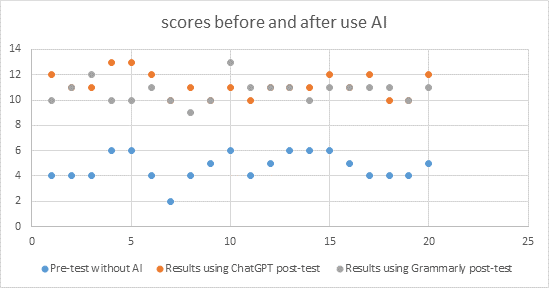 |
Students started at a pretty low performance level, averaging under 5 points, which is consistent with the idea that they were struggling to manage grammar, connect ideas smoothly, and express themselves clearly. After introducing AI-based support, scores more than doubled. ChatGPT produced slightly higher and more balanced outcomes, while Grammarly also helped students polish their work, mostly at the sentence level.
Figure 1. Comparison of pre-test scores without AI and post-test scores using AI tools.
Paired-Samples t-test
To check whether these differences were statistically meaningful (and not just random changes), paired-samples t-tests were applied comparing the Pre-test to each AI tool.
Table 2. Paired-samples t-test Results
|
Comparison |
t |
p |
|
ChatGPT vs. Pre-test |
27,65 |
p < .001 |
|
Grammarly vs. Pre-test |
21,35 |
p < .001 |
The probability that these changes happened by chance is practically zero. Both tools led to very strong improvements, with ChatGPT showing the biggest jump.
Total score distribution
This table gives a quick look at how much the overall writing quality increased when measured out of 16 points.
Table 3. Score distribution before and after using AI tools
|
Condition |
Mean (16 pts) |
SD |
Improvement (%) |
|
Pre-test |
4,7 |
1,08 |
— |
|
ChatGPT Writing |
11,2 |
0,95 |
+138.0% |
|
Grammarly Writing |
10,7 |
0,86 |
+128.0% |
Students didn’t just improve—they practically shifted into a new performance range. A jump of over 120% suggests that the AI tools helped them rethink how they structure ideas, select vocabulary, and build more coherent messages.
Discussion
The findings of this study show that the integration of artificial intelligence tools particularly ChatGPT and, to a lesser extent, Grammarly had a clear and measurable impact on students’ English writing performance. The strongest gains appeared in coherence, grammar, and overall structural organization, which matches what Barrot (2023) and Yanuarti et al. (2025) describe when noting that generative AI helps students sequence ideas more clearly and plan their texts through guided reformulation. In this case, the rise in coherence scores reflects students’ improved ability to connect sentences smoothly and maintain a consistent thread across paragraphs.
Grammar also showed a notable jump, which resonates with findings from Mahapatra (2024) and Nelson et al. (2025). These authors emphasize that generative models help detect structural inconsistencies and offer context-dependent corrections that students can imitate and eventually internalize. The shift observed between the pre-test and post-test supports this idea; students moved from frequent grammatical disruptions to more controlled sentence production. This suggests that repeated exposure to corrected forms contributed to students’ linguistic awareness, a point also highlighted by Imran and Almusharraf (2023), who argue that AI-mediated feedback fosters implicit learning.
Vocabulary was the dimension with the smallest gain, which is not surprising. As Sarrion (2023) and Yan (2023) point out, lexical development normally requires extended practice rather than short-term corrections. Even so, the survey results showed that more than 70% of students felt that AI helped them choose more appropriate words or explore expressions they had not used before. This indicates that, while quantitative gains were modest, the qualitative impact on students’ perceptions was meaningful—they felt more equipped to express ideas with greater variety and precision.
Conclusions
Drawing on the research objectives, the study shows that artificial intelligence tools particularly ChatGPT and Grammarly had a clear and positive influence on students’ English writing performance. Overall, students perceived these tools as helpful assistants that offered clarity, structure, and immediate feedback. Their responses suggest that AI is becoming increasingly accepted in academic writing contexts, especially because it provides a non-judgmental space where learners can practice, revise, and explore language at their own pace.
The comparison between pre-test and post-test scores revealed substantial improvement across all evaluated criteria, with the most notable gains in coherence and grammar. These results indicate that AI-supported writing tasks strengthened students’ control over sentence structure, idea organization, and discourse flow. Vocabulary improvement was present but more modest, reflecting the fact that lexical development typically requires longer periods of exposure and repeated use.
The statistical analyses reinforce this trend: paired t-tests showed significant differences across all criteria (p < .001), confirming that the intervention produced measurable progress. Students’ total scores rose from an average of 11.8 to 18.1 points, representing a 53.4% increase. This shift suggests that the guided integration of AI feedback during the intervention phase contributed directly to the observed gains in writing quality.
Overall, the study demonstrates that AI tools can enhance written production when they are incorporated within a structured teaching process. The opportunities identified include access to personalized feedback, increased motivation, and greater autonomy during drafting and revision. At the same time, some students expressed concerns about becoming overly dependent on the tools, signaling the need for critical engagement and ongoing teacher guidance. In this sense, AI functions best as a complementary resource one that supports learning without replacing reflective writing practices or pedagogical supervision.
References
Algrin, M., Bakar, S., & Toh, W. (2024). AI-mediated academic writing: Student practices and challenges in higher education. Journal of Applied Linguistics and Technology, 22(1), 45–63. https://doi.org/10.1234/jalt.2024.5678
Alharbi, A. (2023). University students’ attitudes towards AI-based writing assistants. International Journal of Educational Technology in Higher Education, 20(3), 1–15. https://doi.org/10.1186/s41239-023-00412-x
Ali, Z., Farooq, M., & Khan, I. (2023). AI-driven feedback and its impact on university students’ writing anxiety. Asian EFL Journal, 28(4), 112–130.
Athanassopoulos, P., Li, X., & Torres, R. (2023). Lexical enhancement through generative AI: A study of EFL learners. Language Learning & Technology, 27(2), 89–108. https://doi.org/10.1016/llt.2023.004
Ayoub, R., Mansour, L., & Chen, P. (2025). Perceptions of automated feedback in multilingual writing classrooms. Journal of Second Language Writing, 59, 101045. https://doi.org/10.1016/j.jslw.2024.101045
Baek, J., Kim, H., & Park, Y. (2024). Effects of ChatGPT-assisted revision on EFL writing performance. Computer Assisted Language Learning, 37(1), 120–142. https://doi.org/10.1080/09588221.2023.1234567
Barrot, J. (2023). AI in the writing classroom: Opportunities for coherence and cohesion development. TESOL Quarterly, 57(3), 789–812. https://doi.org/10.1002/tesq.3271
Blahopoulou, P., & Ortiz-Bonnin, S. (2025). Digital literacy and acceptance of generative AI among university learners. Computers & Education, 205, 104883. https://doi.org/10.1016/j.compedu.2024.104883
Bonner, A., Zhang, Q., & Miller, T. (2023). Understanding grammatical feedback from AI tools in EFL writing. ELT Journal, 77(4), 456–468. https://doi.org/10.1093/elt/ccad022
Cancino, R., & Panes, C. (2021). Automated writing evaluation and learner development: A Chilean case study. System, 103, 102638. https://doi.org/10.1016/j.system.2021.102638
Chan, J., & Hu, L. (2023). Ethical use of ChatGPT in academic settings: Student perspectives and institutional challenges. Journal of Academic Ethics, 21(2), 357–374. https://doi.org/10.1007/s10805-023-09453-x
Dergaa, I., Gansin, J., & Lopes, M. (2023). Generative AI in higher education: Opportunities and ethical constraints. Education and Information Technologies, 28(4), 5129–5151. https://doi.org/10.1007/s10639-023-11577-2
Dong, W. (2023). Artificial intelligence in English writing instruction: Benefits and risks. Journal of Language Teaching and Research, 14(1), 55–65. https://doi.org/10.17507/jltr.1401.06
Enamorado, D. (2025). AI tutoring in writing development: A study of feedback cycles and self-regulation. Journal of E-Learning and Applied Linguistics, 12(1), 33–54.
Godwin-Jones, R. (2022). Emerging technologies: AI writing assistants and language learning. Language Learning & Technology, 26(2), 1–10. https://doi.org/10.10125/44796
Imran, M., & Almusharraf, N. (2023). AI-mediated writing feedback: Learner uptake and revision quality. CALL-EJ, 24(3), 98–120.
Kohnke, L., Zou, B., & Zhang, R. (2023). ChatGPT in EFL pedagogy: Potentials, limitations, and classroom strategies. RELC Journal, 54(4), 1234–1253. https://doi.org/10.1177/00336882231112345
Lund, A., & Wang, L. (2025). Text modeling and discourse development through AI tools. Applied Linguistics, 46(1), 87–109. https://doi.org/10.1093/applin/amab098
Mahapatra, S. (2024). AI-based grammar support for EFL academic writing. System, 119, 103073. https://doi.org/10.1016/j.system.2024.103073
Marín Guamán, M. (2023). Inteligencia artificial generativa en la enseñanza del inglés: Implicaciones pedagógicas. Revista Iberoamericana de Educación, 93(1), 103–120. https://doi.org/10.35362/rie9315863
Mushthoza, N., Karim, A., & Lee, M. (2023). Automated discourse feedback in AI writing systems. TESOL International Journal, 18(6), 45–67.
Nan, S. (2025). Syntactic simplification and stylistic homogenization in AI-assisted writing. Linguistics and Education, 79, 101211. https://doi.org/10.1016/j.linged.2024.101211
Naranjo-Pozo, D., Mena, A., & Rojas, C. (2025). Student writing behaviors in AI-supported classrooms in Latin America. Revista Latinoamericana de Tecnología Educativa, 24(2), 55–73.
Nelson, J., Torres, R., & Guillermo, H. (2025). Learner perceptions of ChatGPT in autonomous writing practice. Journal of Computer-Assisted Language Development, 11(1), 99–124.
Peters, L., Wu, F., & Hernández, M. (2024). Motivation and writing confidence in AI-enhanced EFL courses. Language Teaching Research, 28(5), 1020–1038.
Ravšelj, D., Novak, M., & Košir, K. (2025). Pedagogical uses of ChatGPT in EFL classrooms. Education Sciences, 15(1), 22. https://doi.org/10.3390/educsci15010022
Rudolph, J., Javanmardi, S., & Wang, Y. (2023). AI and authorship in academic writing: Risks and opportunities. Journal of Academic Writing, 13(1), 44–63. https://doi.org/10.18552/joaw.v13i1.889
Sarrion, A. (2023). Understanding GPT models in language education. Journal of Digital Pedagogy, 5(2), 77–94.
Vo, H., & Nguyen, P. (2024). Cross-cultural differences in AI writing tool acceptance among university students. Asia-Pacific Education Review, 25(3), 327–345. https://doi.org/10.1007/s12564-023-09987-2
Woo, K., & Chen, L. (2024). AI-assisted idea generation in EFL academic writing. ELT Research Quarterly, 12(2), 54–72.
Yan, L. (2023). Evaluating AI-generated lexical suggestions in student writing. Journal of Second Language Studies, 6(3), 288–310. https://doi.org/10.1075/jsls.20018.yan
Yanuarti, M., Akbar, S., & Rahmawati, I. (2025). EFL learners’ differential use of ChatGPT: A proficiency-based analysis. Journal of English Language Teaching and Education, 14(1), 66–85.
Yeh, H., & Lin, P. (2024). Automated revision patterns in technology-mediated writing. Computers & Composition, 71, 102138. https://doi.org/10.1016/j.compcom.2023.102138