Fecha de recibido: 21/11/2025
Fecha de aceptado: 23/01/2026
Fecha de publicado: 09/02/2026
Introduction
Mastery of academic English remains a major challenge, even for instructors of English as a Foreign Language (EFL), particularly at the tertiary level in countries where higher education is delivered through non-English medium instruction. Research studies have indicated that knowledge of academic vocabulary is crucial for reading comprehension, academic writing and knowledge building, but it remains one of the most challenging areas that EFL learners have to confront mainly due to the infrequent, abstract, and discipline-specific nature of academic vocabulary (Nation & Webb, 2022; Lei & Liu, 2021).
This issue has highlighted the need for methodologies that go beyond the traditional teaching of memorizing lexical lists and disjointed exercises. In this context, emerging literature characterizes the Content and Language Integrated Learning (CLIL) as a 21st century pedagogy, which combines content and language learning, enabling learners to gain academic vocabulary in authentic contexts, fostering motivation, academic engagement, and the productive and skillful use of language in writing and speaking (Hidalgo & Ortega-Sánchez, 2023; Kuravska & Bilyanska, 2023).
Research conducted at the higher education institutions of Latin America shows that university learners' command of academic English is limited despite years of formal instruction and they tend to use only high-frequency words, which makes it difficult for them to perform complex academic tasks; this tendency that could be due to methodologies focused mainly on grammar and learning isolated words (Zhi & Wang, 2023). At the local level, this situation is evident in the students from the National and Foreign Language Career at Cotopaxi Technical University, who, according to diagnostic assessments and classroom observation, have difficulties to read and write coherent papers in English, which negatively affects their learning motivation and self-esteem. In response to this issue, this study aims to investigate the impact of the CLIL approach on the development of academic vocabulary in fourth-cycle students, to discover what are the most lexically problematic points, and to see if content and language integrated activities support reading skill and enhance the appropriate use of academic vocabulary in real learning environments.
Recent research highlights the importance of dynamic, emotionally responsive, and reflective pedagogical practices in English as a Foreign Language (EFL) contexts. Rang and Yongliang (2023) argue that interactive and emotionally supportive teaching approaches significantly enhance second language acquisition by fostering creativity, motivation, and professional fulfillment among teachers. This perspective aligns with Shrestha et al. (2023), who examine EFL teachers’ perceptions of Exploratory Action Research (EAR) as a tool for improving classroom practice.
Their findings suggest that systematic reflection and data-informed reporting enable teachers to recognize meaningful changes in both teaching effectiveness and learner engagement. Complementing this view, Hidayat et al. (2023) identify key factors influencing teacher creativity in English Language Teaching (ELT), including the integration of creative practices, the promotion of enjoyable learning experiences, and the encouragement of students creativity. Collectively, these studies emphasize that emotional informed, reflective, and creative teaching practices contribute to more effective EFL learning environments.
Within this pedagogical framework, academic vocabulary emerges as a critical component of language proficiency and academic success. Khalilova (2023) underscores the role of academic vocabulary in developing learners’ lexical competence, critical thinking, and decision-making skills across educational levels. Despite extensive research attention, persistent challenges remain regarding effective instructional strategies for teaching academic vocabulary, particularly in higher education contexts where both native and non-native English speakers experience difficulties.
Addressing this gap, Brooks et al. (2023) provide empirical evidence demonstrating that vocabulary knowledge is a stronger predictor of reading comprehension among English as an Additional Language (EAL) learners than decoding skills, fluency, or general linguistic competence. Their findings, based on a case study in an international school in Japan, highlight the necessity of targeted language-based interventions to support students’ comprehension of academic text. Together, these studies reinforce the centrality of vocabulary instruction in providing academic literacy and comprehension in EFL and EAL contexts.
Against this background, Content and Language Integrated Learning (CLIL) has gained prominence as an instructional approach that simultaneously develops language and subject matter knowledge. Originally introduced by David March in 1994, CLIL emerged within European multilingual education policies to address the need for a more effective language learning model. Hidalgo and Ortega Sánchez (2023) describe CLIL as an approach that integrates language learning with disciplinary content, enabling learners to use the target language for authentic academic purposes rather than purely communicative goals.
Similarly, Chantal and Banegas (2021) trace the theoretical foundations of CLIL, emphasizing its alignment with the 4Cs framework “Content, Communication, Cognition, and Culture” and its interdisciplinary grounding in education, linguistics, and psychology. Empirical evidence from diverse contexts further supports its pedagogical value. Casa and Rengifo (2023), for instance, report positive students' perceptions of CLIL in Ecuadorian secondary education, particularly in terms of motivation, cultural awareness, and the development of receptive and productive language skills. These findings illustrate CLIL’s capacity to connect language learning with meaningful content and local cultural contexts.
Nevertheless, the effectiveness of CLIL continues to be debated, particularly regarding its impact on content learning outcomes. Zakhareyych (2025) and Kurayska and Bilyanska (2023) emphasize the methodological strengths of CLIL, including increased motivation, critical thinking development, and intercultural competence, while also acknowledging challenges related to teacher preparation, assessment practices, and material adaptation. Large-scale and review-based studies present a more nuanced picture. Peizhen Lyu (2022) and Gao and Wang (2025) report that although CLIL often leads to improvements in language proficiency and learner motivation, its effects on subject matter learning are comparable to those of traditional instruction.
Similarly, Hidalgo and Ortega Sánchez (2023) and Bin Saran (2021) call for more longitudinal and context sensitive research to better understand CLIL’s long term impact across educational levels. Recent studies focusing on assessment literacy (Jiajia et al., 2024) and vocabulary development (Escalante et al., 2023) further suggest that CLIL’s success depends on informed pedagogical implementation and institutional support. Overall, while CLIL is widely recognized as a promising and innovative approach, continued empirical investigation is necessary to optimize its application and address existing limitations in EFL and multilingual education contexts.
Additionally, Sarabia Oñade (2021) noted that evolving educational contexts have prompted changes in the EFL teaching methodologies, with a growing emphasis on the integrated development of the four language skills. In line with the shift, the Ministry of Education adopted a curriculum grounded in the CLIL approach of 2016, suggesting foreign language instructions through disciplinary content and learners’ needs in order to foster meaningful and functional language competence. With this framework, the current study addresses the following research questions:
· To what extent does CLIL-based instructions enhance students’ academic vocabulary knowledge in EFL higher education context?
· How does CLIL-based instructions influence student productive use of academic vocabulary in EFL higher education context?
Materials and Methods
The research design of the present study was mixed methods research, which can be characterized as sequential explanatory design including a qualitative phase following a quantitative phase to investigate the effect of Content and Language Integrated Learning (CLIL) on teaching and learning of academic vocabulary. The qualitative component was introduced to provide contextually rich data on learners’ insights and classroom routines, comparing with the numerical result-oriented data of learning accomplishment from the quantitative component. The combination of two methods enabled a more comprehensive understanding of the findings by illustrating quantifiable results and educational processes behind them.
This study is of an exploratory type because it deals with a subject which has not been much explored in the local context—semantically, the employ of CLIL to support academic vocabulary learning of the 4th cycle students of English major of the Pedagogy of National and Foreign Languages at the Technical University of Cotopaxi. Since the CLIL based theoretical models are scarcely implemented in the local context, this study can also be considered as a diagnostic one. A pre-test on academic vocabulary was given before the intervention in order to assess students' initial knowledge, their strong points, and the aspects that required more attention. These results served as a basis for the development and implementation of CLIL lessons adapted to the needs of the students.
In addition, the research is descriptive in that it tries to capture and analyze the changes in students’ growing academic vocabulary after having undergone the CLIL experience. Special consideration was given to changes in learner written and oral production as participants worked in meaningful, content-based tasks. Instruments for data collection involved vocabulary knowledge pre- and post-tests before and after the intervention, CLIL unit plans, and a series of classroom activities that led students to actively participate and to use vocabulary in context.
In order to further enhance the information, both the written and oral products of the students were assessed through analytic rubrics with explicit criteria which facilitated a systematic evaluation of the accuracy, appropriateness and contextualization of the vocabulary items. Observations in the class corroborated qualitative evidence of learners’ motivation, engagement, interaction and a shared sense of belonging to a vibrant community of learners. Data analysis included statistical analyses of pre- and post-test scores to quantify gains, as well as descriptive analyses of rubric scores and observational data. The combination of these data sources added credibility to the findings and enabled a holistic evaluation of the effect of the CLIL method on learning academic vocabulary.
Results and Discussion
A general analysis of the pre-test and post-test results of the fourth-cycle students of the Pedagogy of National and Foreign Language program at the Technical University of Cotopaxi, revealed marked variability in performance. Nine students (47.96) showed the lowest scores, corresponding to the A1 level, reflecting limited control across all the vocabulary frequency bands, particularly the 3000+ band and the AWL. Thirty students (49.34) and 17 students (52.22) reported minor low scores, suggesting that only a small group demonstrated relatively adequate academic lexical competence prior to the intervention, while most clustered at A1-A2 level. The CLIL-based teaching instructions indicated substantial improvements, the lowest scores increased, with 26 students obtaining 62.35 (A1), followed by 28 students (63.16) and 20 students (63.34), indicating an overall upward shift in the performance levels.
The highest post-test score was obtained by 9 students (99.81, B2 level), representing a notable gain from A1 to B2, a progress also observed in 17 students (99.47), 11 students (98.70), 22 (98.70), and 23 students (98.70), all these students achieved B2. Overall, the comparison between pre-test and post-test score demonstrates a substantial progression from A1-A2 to B1-B2, particularly in high-frequency and academic vocabulary bands, providing quantitative evidence of the effectiveness of the CLIL approach.
Table 1. Students’ English vocabulary level
|
Pre- test |
Post-test |
||||||||
|
CEFR English Level and vocabulary size |
NVLT Result |
N° Students |
Percentage |
CEFR English Level and vocabulary size |
NVLT Result |
N° Students |
Percentage |
||
|
A1 |
1000 |
0% - 71,40% |
15 |
48,39% |
A1 |
1000 |
0% - 71,40% |
3 |
9,68% |
|
A2 |
2000+AWL |
71,41% - 86,09% |
10 |
32,26% |
A2 |
2000+AWL |
71,41% - 86,09% |
8 |
25,81% |
|
B1 |
>2000+AWL |
86,10% - 97,99% |
6 |
19,35% |
B1 |
>2000+AWL |
86,10% - 97,99% |
15 |
48,39% |
|
B2 |
5000+AWL |
98% - 100% |
0 |
0% |
B2 |
5000+AWL |
98% - 100% |
5 |
16% |
|
Total |
|
31 |
100% |
Total |
|
|
31 |
100% |
|
Table 1 reports the positive effect of the CLIL-based intervention on students’ English vocabulary development. Most students were grouped in the lowest proficiency levels in the pre-test, with 15 students (48.39%) at the A1 level, meaning that they have a limited vocabulary knowledge which is mostly based on the 1000-word frequency range, and 10 students (32.26%) were at the A2, describing partial control of the 2000-word range and items from the AWL. Only 6 students (19.35%) indicated to be at the B1 level while any student was found at the B2 level. In contrast, the post-test results indicate a clear shift in lexical competence: only three students (9.68%) remained at the A1 level, while eight students (25.81%) were classified at A2.
This redistribution across proficiency levels suggests that a substantial proportion of learners progressed beyond the lowest bands, reflecting measurable gains in academic vocabulary following the intervention. Most notably, the proportion of students at the B1 level increased to 15 (48.39%), representing the largest group, while five students (16%) reached the B2 level, a category absent in the pre-test. This redistribution across CEFR levels reflects a marked reduction in low-level academic vocabulary knowledge and a clear shift toward higher lexical competence. Gains were particularly evident in vocabulary beyond the 2,000-word level and in AWL coverage. Overall, the comparison indicates that the CLIL approach was fundamental in improving students’ academic vocabulary knowledge, allowing a significant proportion of them to progress from elementary to independent and advanced language users, according to the CEFR.
Table 2. Writing and Speaking activities
|
Scales |
Points |
Writing |
Percentage |
Speaking |
Percentage |
|
Needs improvement |
0 to 5 |
0 |
0,0 |
0 |
0 |
|
Acceptable |
6 to 8 |
0 |
0,0 |
4 |
12,9 |
|
Good |
9 to 12 |
4 |
12,9 |
18 |
58,1 |
|
Excellent |
13 to 16 |
27 |
87,1 |
9 |
29,0 |
|
TOTAL |
31 |
100,0 |
31 |
100,0 |
|
As shown in Table 2, the writing and speaking activities indicate highly positive outcomes in students’ use of academic vocabulary during the CLIL-based intervention. No student was classified in the “Needs Improvement” category in either skill, demonstrating that all participants achieved at least a minimum acceptable level of academic language use. In writing, the results are very positive, with 27 students out of 31 (87.1%) achieving an “Excellent” level, while 4 were classified in the “Good” category and none of the students in the “Acceptable” range. That is, the majority of students successfully incorporated academic vocabulary into their well-organized and coherent work, with acceptable grammatical accuracy.
The speaking results are slightly more heterogeneous, but still largely positive: 18 students (58.1%) reached the "Good" level and 9 (29.0%) the "Excellent" level, reporting solid oral performance in terms of fluency, clarity of ideas, pronunciation, and use of academic vocabulary. Four students reached the "Acceptable" level, but none fell below the lowest level. Taken together, these data support the claim that the integrated writing and speaking activities used throughout the program provided students with a more objective perception of their own development and further illustrate that CLIL-based tasks appear to be the most effective means of improving students' writing skills, in addition to producing remarkable results in their oral expression skills in an academic context.
Table 3. Comparison Table
|
English level |
Pre-test results |
Percentage |
Post- test results |
Percentage |
|
A1 |
15 |
48,39% |
3 |
9,68% |
|
A2 |
10 |
32,26% |
8 |
25,81% |
|
B1 |
6 |
19,35% |
15 |
48,39% |
|
B2 |
0 |
0% |
5 |
16% |
|
Total |
31 |
100% |
31 |
100% |
Table 3 above shows a comparison of students' CEFR English levels before and after the teaching experiment, based on a sample group. The difference between the pretest and posttest results is positive across the entire sample (indicating an upward trend). The largest difference was found at level A1, which dropped dramatically from 15 students (48.39%) in the pre-test to 3 students (9.68%) in the post-test, indicating that the majority of students had passed the beginner level and had acquired a better command of fundamental vocabulary. This reduction of almost 40 percentage points can be considered compelling evidence of the teaching's effectiveness. At the A2 level, there was a slight decrease from 10 students (32.26%) to 8 students (25.81%), indicating that while some students remained at this level, others progressed to higher levels of proficiency. This highlights the need for sustained, focused support for those still becoming familiar with academic vocabulary. The largest increase was observed at the B1 level, which rose from 6 students (19.35%) in the pre-test to 15 students (48.39%) in the post-test, an increase of almost 30 percentage points.
This demonstrates that nearly half the class reached the intermediate level of proficiency, making them more competent and confident in reading academic texts and teaching in content-based programs. Furthermore, the CLIL-based intervention was effective since students achieved the B2 level in the post-test (this level was not present at all in the pre-test), which corresponds to greater vocabulary acquisition and improved preparation for higher-level academic work. In short, the transition between lower and higher CEFR levels is undeniable proof, especially with the CLIL approach, as it helped improve students' academic vocabulary, language proficiency, and overall language development.
Table 4. Descriptive Table
|
Category |
Score |
SD |
F |
P- value |
|
Pre- test |
70,62 |
13,977 |
31,895335 |
0.000000472 |
|
Post- test |
88,31 |
10,435 |
Table 4 above, presents the statistical significance of the CLIL-based intervention within the classroom. It can be seen from the data a striking and dramatic improvement in student performance on the post-test. Students who took the pre-test before the instructions indicated a moderate level of vocabulary knowledge (70.62) and a substantial amount of variation among students (13.977). After CLIL-based instruction, students reported a substantial increase, not only in the average level of student achievement academic vocabulary (88.31) but also an improvement in student homogeneity (10.435). The ANOVA supports this claim as the p-value (0.000000472) is below the α level of 0.05 significance. This implies that the observed difference in pre-test and post-test scores is statistically significant and highly positive. Therefore, the findings provide strong empirical evidence for the effectiveness of the CLIL model in boosting students' acquisition of academic vocabulary.
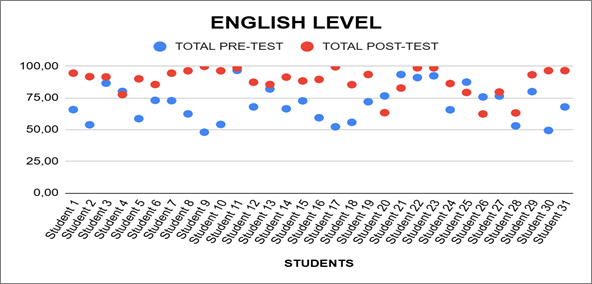
Figure 1. Scatter plot
This scatter plot shows a unique comparison of each student's total score on the pre-test (blue dots) with their total score on the post-test (red dots). The individual student analysis shows that almost all students tended to improve from the pre-test to the post-test, indicating that, overall, all achieved a higher score on the post-test. Students who scored low or moderate on the pre-test (approximately 50-65) showed the most significant improvement; their post-test scores reached the 80-95 range, suggesting that the educational intervention was most effective among the lower-performing students. Students who already had relatively high scores on the pre-test also improved, although their improvements were naturally smaller because they started from a higher position. Crucially, there were no obvious cases of a decline in scores from the pre-test to the post-test, indicating that no participant was negatively impacted by the CLIL-based intervention. Taken together, these results indicate a very homogeneous individual development and confirm that the performance improvements were not limited to a particular group of students but encompassed the whole class.
Discussion
The results indicate that prior to the CLIL-based intervention, students began with generally low to intermediate levels of academic vocabulary, with the majority classified at CEFR A1 and A2 levels. These results reflect the trends observed in previous EFL research studies (e.g., Tovar, 2017, 2019), which supports the claim that university students with a non-equivalent level of English tend to rely on high-frequency vocabulary and have a weaker command of academic vocabulary (Nation & Webb, 2022; Lei & Liu, 2021). After the CLIL-based intervention, the trend was different: students showed progress towards higher levels of proficiency, with a notable increase at level B1 and the emergence of B2-level students, who were absent in the pre-test. This transition implies not only a quantitative expansion of vocabulary but also a qualitative improvement in the depth of lexical and academic preparation. This is consistent with research of Hidalgo and Ortega-Sánchez, 2023; Kuravska and Bilyanska (2023), who used content-based learning and CLIL approach as the key sources to improve learners’ acquisition of academic vocabulary. From a methodological perspective, the combination of quantitative and qualitative methods allowed researchers to achieve a more comprehensive and valid understanding of the effects of CLIL-based instructions.
The quantitative results showed statistically significant increases in students' vocabulary test scores; the qualitative data, obtained through systematic classroom observation and analysis of students' written and oral texts, revealed that students were more confident, accurate, and contextualized when using academic vocabulary. This methodological combination improved the robustness and validity of the findings and indicated greater individual progress among students who started with a lower proficiency level, implying that CLIL instructions function as an efficient pedagogical strategy for narrowing gaps in lexical competence, consistent with the findings of BinSaran (2021) and Shykun (2023). However, in line with the literature that emphasizes the unpredictability of CLIL outcomes (Lyu, 2022; Gao & Wang, 2025), it is important to consider that the present study focused solely on the development of academic vocabulary, and that further research should examine whether CLIL facilitates language development, disciplinary content learning, or both.
The findings further reveal that the adoption of CLIL-based instructions had the greatest positive effect on students' productive skills, particularly in writing and then in speaking. The high percentage of students achieving the "Excellent" range in writing aligned with the findings of Escalante et al. (2023) and Sarabia Oñade (2021), who argued that CLIL-based tasks provided students with opportunities to integrate academic vocabulary into meaningful and cohesive written texts. Sarabia Oñade (2021) states that context- and content-based activities lead to a strengthening of functional vocabulary application. Although the speaking results are slightly variable, the predominance of "Good" and "Excellent" ranges indicates that CLIL represents significant support for students' oral production of academic language, as it fostered fluency, clarity, and lexical appropriateness of choice. These findings further support the idea that CLIL promotes real communicative contexts that encourage students to actively use academic vocabulary across multiple modalities, rather than merely recognizing it receptively.
Regarding the effect of the CLIL-based intervention on vocabulary learning, the statistical analyses revealed that the CLIL intervention was beneficial for students in terms of vocabulary learning. The mean scores, the decrease in variability (Sd), and the highly significant p-value (0.000000472) indicate that the improvements were not accidental, but rather due to the CLIL-based instructional approach. This result is in line with those of BinSaran (2021) and Shykun (2023), who highlighted that CLIL approach functions as a compensatory approach, supporting students with low proficiency levels while simultaneously strengthening overall cohort proficiency. The alignment with the conceptual models discussed above, particularly the acquisition of conventionalized linguistic signs, together with the observed quantitative and qualitative gains in writing, speaking, and classroom participation, indicates that CLIL extends beyond vocabulary growth to promote authentic language use and increased learner confidence. These results are consistent with some research studies (c.f., BinSaran, 2021; Shykun, 2023; Hidalgo & Ortega-Sánchez, 2023; Kuravska & Bilyanska, 2023; Escalante et al., 2023; Sarabia Oñade, 2021) discussed in previous paragraphs and position CLIL as a viable pedagogical approach for promoting academic vocabulary in EFL higher education settings.
Conclusions
The results of this research allow us to infer that the CLIL approach had a positive, stable, and statistically significant impact on improving academic vocabulary among fourth-cycle students of Pedagogy of National and Foreign Languages at the Technical University of Cotopaxi. English language instruction combined with content area courses resulted in a more contextual, functional, and meaningful learning of academic vocabulary, as shown by the quantitative results of the pre- and post-tests, as well as the qualitative results of the students' written and oral productions. The significant increase in mean scores, the decrease in the variability of results, and the trend of positive changes across CEFR proficiency levels suggest that CLIL is effective in fostering lexical competence in tertiary EFL settings by promoting the task-based use of academic vocabulary in authentic academic tasks.
Furthermore, the findings also showed that, throughout the treatment, the CLIL-based instructions promoted a more homogeneous distribution of performance in terms of language skills across the group by mitigating the differences between more and less advanced students based on their prior vocabulary knowledge. Beginner students who started at lower proficiency levels exhibited greater gains, further indicating that CLIL is a compensatory pedagogical approach that promotes equal opportunity and access in the acquisition of academic vocabulary. The results of the writing and speaking activities indicated that students were more accurate, consistent, and appropriate in the use of academic vocabulary, particularly in their written work, and at the same time, they achieved significant improvements in oral fluency and intelligibility.
Although the findings are promising, they must be interpreted with caution due to several limitations such as the relatively small sample size and the lack of a control group, as well as a short intervention period, which limit both generalizability and the assessment of long-term learning effects. Future research should therefore address larger sample sizes, experimental/quasi-experimental methodologies, longitudinal designs, and a more comprehensive examination of disciplinary content learning and teacher training in higher education settings, particularly in Latin American context, in order to consolidate evidence for CLIL as an effective approach to teaching academic English in EFL contexts.
References
BinSaran, A. A. (2021). Use of content and language integrated learning for teaching reading skills in Saudi universities. English Language Teaching, 14(8), 1–12. https://files.eric.ed.gov/fulltext/EJ1309578.pdf
Brooks, G., Clenton, J., & Fraser, S. (2023). Exploring the Importance of vocabulary for English as an additional language learners' reading comprehension. In EAL Research for the Classroom (pp. 35-58). Routledge. https://www.taylorfrancis.com/chapters/edit/10.4324/9781003274889-5/exploring-importance-vocabulary-english-additional-language-learners-reading-comprehension-gavin-brooks-jon-clenton-simon-fraser
DeLuca, C., Lapointe-McEwan, D., & Luhanga, U. (2024). CLIL teachers’ assessment literacy: A scoping review. Teaching and Teacher Education, 135, 104150. https://doi.org/10.1016/j.tate.2023.104150
Escalante Gamazo, M. C., Arias Quinga, E. P., & Sulca Guale, X. (2023). Promote vocabulary learning in context through the CLIL methodology. Revista DATEH, 14(2), 66–78. https://investigacion.utc.edu.ec/index.php/dateh/article/view/685
Gao, Y., & Wang, Y. (2025). Effects of content and language integrated learning on secondary students’ content learning: A meta-analysis. System, 116, 103580. https://doi.org/10.1016/j.system.2024.103580
Hidalgo , D. R., & Ortega-Sánchez, D. (2023). CLIL (Content and Language Integrated Learning) Methodological Approach in the Bilingual Classroom: A Systematic Review1. International Journal of Instruction, 16(3), 915–934. Retrieved from https://e-iji.net/ats/index.php/pub/article/view/114
Hidalgo, C., & Ortega-Sánchez, D. (2023). Effects of content and language integrated learning on academic vocabulary development and learner motivation in higher education. Journal of Language Teaching and Research, 14(2), 245–258. https://doi.org/10.17507/jltr.1402.08
Hidayat, D. N., Fitriah, Mahlil, & Mason, J. (2023). Factors Impacting English Teachers’ Creativity in Teaching English as a Foreign Language in Indonesia. Studies in English Language and Education, 10(1), 155-173. https://doi.org/10.24815/siele.v10i1.26145
Khalilova , K. (2023). ACADEMIC VOCABULARY: HOW TO TEACH AND STUDY IT. Modern Science and Research, 2(9), 79–83. Retrieved from https://inlibrary.uz/index.php/science-research/article/view/23902
Khalilova, N. (2023). Traditional versus contextualized vocabulary instruction in EFL classrooms: Implications for long-term retention. International Journal of Applied Linguistics and English Literature, 12(1), 33–41. https://doi.org/10.7575/aiac.ijalel.v.12n.1p.33
Kuravska, N., & Bilyanska, I. (2023). Increasing the effectiveness of foreign language learning through content-language integrated learning (CLIL). Journal of the Vasyl Stefanyk Precarpathian National University. Philology , (10), 38–46. https://doi.org/10.15330/jpnuphil.10.38-46
Kuravska, N., & Bilyanska, O. (2023). Integrating academic vocabulary through CLIL: A learner-centered approach in tertiary education. TESOL Quarterly, 57(1), 189–207. https://doi.org/10.1002/tesq.3175
Lei, L., & Liu, D. (2021). Vocabulary knowledge and academic English proficiency among EFL learners at the tertiary level. System, 97, 102432. https://doi.org/10.1016/j.system.2021.102432
Peizhen Lyu. (2022). How does Content and Language Integrated Learning (CLIL) Influence University Students’ English Acquisition? A Systematic Literature Review. Research and Advances in Education, 1(6), 28–37. Retrieved from https://www.paradigmpress.org/rae/article/view/355
Reynaert, B. (2024). Effect of language learning strategies on vocabulary development in CLIL. Porta Linguarum An International Journal of Foreign Language Teaching and Learning, (41), 225–240. https://doi.org/10.30827/portalin.vi41.27217
Sarabia Oñate, M. A. (2021). CLIL approach for the development of English vocabulary among teenagers. Pontificia Universidad Católica del Ecuador. https://repositorio.puce.edu.ec/handle/123456789/9395
Shrestha, S., Laudari, S., & Gnawali, L. (2023). Exploratory action research: Experiences of Nepalese EFL teachers. ELT Journal: an international journal for teachers of English to speakers of other languages, 77(4), 407-415. https://doi.org/10.1093/elt/ccac029
Shykun, A. (2023). Content and language integrated learning: Enhancing language acquisition and content understanding. International Science Journal of Education & Linguistics, 2(3), 45–56. https://isg-journal.com/isjel/article/view/455
Tovar, R. (2017). Vocabulary knowledge in the production of written texts: a case study on EFL language learners. Revista Tecnológica - ESPOL, 30(3), 89-1-5. https://rte.espol.edu.ec/index.php/tecnologica/article/view/628
Tovar, R., & Tapia, J. (2019). Learning factors in a foreign-language classroom context. REDIPE, 8(7), 113-127 https://doi.org/10.36260/rbr.v8i7.783
Zhi, L., & Wang, Y. (2023). Academic lexical competence of EFL university students: Challenges and pedagogical implications. Asian EFL Journal, 27(3), 112–129. https://www.asian-efl-journal.com
Zhi, R., & Wang, Y. (2023). English as a foreign language teachers’ professional success, loving pedagogy and creativity: A structural equation modeling approach. Thinking Skills and Creativity, 49, 101370. https://www.sciencedirect.com/science/article/abs/pii/S1871187123001384